





The Power of Warrior Three
Beyond the obvious challenge of balancing on one leg, Warrior Three offers a wealth of benefits. Physically, it strengthens the ankles, legs, shoulders, and back muscles while toning the entire core. On your standing leg, it strengthens the quadriceps
and ankle, while the lifted leg gets a powerful hamstring and glute workout. Mentally, the pose demands immense focus and concentration, which can improve mental clarity and reduce stress. It teaches resilience and poise, asking you to find steadiness even when things feel wobbly. This practice of finding your centre translates directly from the mat into daily life, helping you navigate challenges with greater calm and control.
Setting the Foundation: Preparatory Poses
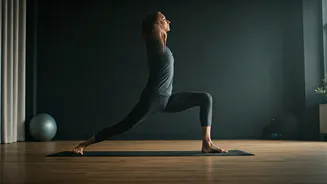
Jumping into Warrior Three without preparation can be difficult. Warming up the body with specific poses will make finding your balance much easier. Focus on poses that build leg strength, open the hips, and engage the core. Good preparatory postures include High Lunge (Anjaneyasana) to get your hips squared, Tree Pose (Vrksasana) to practice one-legged balance, and Standing Splits (Urdhva Prasarita Eka Padasana) to open the hamstrings. Poses like Plank and Boat Pose (Navasana) are also excellent for firing up the core muscles that are essential for stability in the final pose.
How to Enter Warrior Three: A Step-by-Step Guide
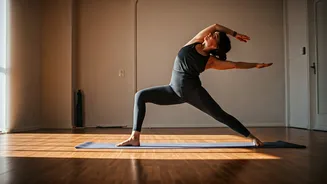
There are several ways to enter the pose, but a common and stable approach is from a High Lunge. Begin in a High Lunge with your right foot forward, knee bent at a 90-degree angle. Bring your hands to your heart in a prayer position. Inhale and find length in your spine. As you exhale, begin to hinge forward from your hips, bringing your torso over your right thigh. Shift your weight into your right foot. Inhale and slowly begin to float your left leg up from the floor. Exhale and continue to lift the left leg and lower your torso until they are both parallel to the floor, forming a 'T' shape with your body. Keep a micro-bend in your standing right knee to avoid locking it. Actively press through your lifted left heel as if stamping it on a wall behind you. Your gaze, or drishti, should be on a fixed point on the floor about a foot in front of you to aid balance. Hold for 5-10 breaths before gracefully returning to your lunge and repeating on the other side.
Common Mistakes and How to Correct Them
Many practitioners struggle with a few key alignment issues in Warrior Three. One of the most common is opening up the hip of the lifted leg. To fix this, actively rotate your lifted thigh inward and point your toes directly down at the mat. Another frequent error is letting the back leg sag or the chest collapse. Counter this by engaging your entire back leg, reaching actively through the heel, and squeezing your shoulder blades together to keep the chest broad. Finally, remember to breathe! Many people hold their breath in balancing poses, which creates tension. A steady, calm breath leads to a steady, calm body.
Modifications for Every Level
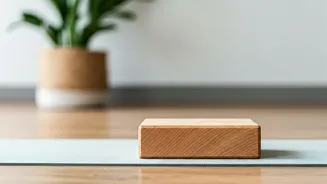
Warrior Three is an intermediate pose, but modifications make it accessible to everyone. If you are new to the pose, practice with your hands on a wall or the back of a chair for support. This allows you to work on your alignment without the full challenge of balancing. You can also use yoga blocks under your hands for stability. Another great modification is to simply not lift the back leg as high; focus on maintaining a long line from your head to your heel at whatever height is manageable. Arm variations also change the difficulty. Keeping hands at your heart or on your hips is easier than extending them forward, which is the most challenging variation.