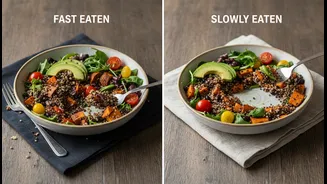









The Foundation of 'Eat Slower'
For decades, health experts and dietitians have championed slower eating as a simple weight management strategy. The core logic is sound and easy to grasp. It takes approximately 20 minutes for your stomach to send signals to your brain that it is full.
Fast eaters can consume a significant number of calories before this signal ever arrives, leading to overeating. Studies have consistently shown that people who report eating quickly are more likely to have a higher Body Mass Index (BMI) and gain more weight over time compared to their slower-eating counterparts. The advice is based on this physiological delay, suggesting that if we simply slow down, we give our bodies a chance to catch up, recognize satiety, and naturally eat less. It’s an appealingly simple solution to a complex problem.
Hormones and Fullness Cues
The communication between your gut and brain is managed by a cocktail of hormones. When you eat, your digestive tract releases hormones like cholecystokinin (CCK) and glucagon-like peptide-1 (GLP-1), which signal fullness. Research indicates that a slower eating pace can increase the production of these satiety hormones. One study observed that participants who took 30 minutes to eat ice cream had significantly higher levels of fullness hormones compared to when they ate it in five minutes. More chewing, a natural consequence of eating slower, has also been linked to a decrease in calorie intake. This hormonal response is the scientific backbone of the “eat slow” mantra; by giving these hormones time to work, you feel fuller on less food, which should, in theory, lead to weight loss over time.
A Key Limitation Emerges
This is where the headline's claim comes into focus. While slowing down can reduce calorie intake during a single meal, its long-term impact on overall body composition isn't guaranteed. Some research has found that while slower eating increased the duration of a meal, it didn't always lead to a statistically significant decrease in calories consumed or an increase in satiety. The effect can also vary between individuals. For example, one study noted that while slowing down boosted fullness hormones in young people with obesity, the same effect wasn't seen in adults with diabetes, even though they reported feeling fuller. This suggests that the connection between eating speed and hormonal response is not a universal one-size-fits-all mechanism. The body is an adaptive system, and factors like metabolic health, existing body weight, and even the type of food consumed can influence the outcome.
Shifting Focus from Speed to Mindfulness
The evidence suggests that the true benefit may not lie in the mechanical act of eating slowly, but in the awareness that accompanies it. This is the principle of mindful eating. Mindful eating is about paying full attention to the experience of eating and drinking, both inside and outside the body. It encourages you to notice the colours, smells, and textures of your food and to listen to your body's natural hunger and fullness cues. While slow eating is a component of mindfulness, it is not the entire practice. Someone can eat slowly while still being distracted by their phone or television, effectively muting their body's signals. Therefore, the emphasis should shift from simply slowing the fork-to-mouth motion to cultivating an environment of awareness around meals.
Practical, Mindful Eating Strategies
Instead of just timing your meals, consider incorporating habits that naturally encourage a more mindful approach. Creating a distraction-free eating environment is a powerful first step—this means putting away phones and turning off the TV. Other effective techniques include putting your utensils down between bites, chewing each mouthful thoroughly, and taking sips of water during your meal. Another helpful tip is to assess your hunger before you even start eating. When you arrive at a meal ravenously hungry, you're more likely to eat quickly and bypass your fullness cues. The goal is to move from a mindless rush to a deliberate and enjoyable experience, which makes it easier to recognize when you are comfortably satisfied, not just physically stuffed.