


A New Geometric Wonder
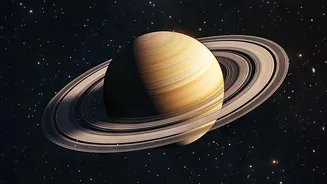
The new atmospheric wave isn't just any storm; it's a massive, 10-sided feature, or decagon, encircling Saturn's south pole. For years, its northern counterpart, a stable hexagon, was considered a one-of-a-kind wonder in the solar system. This new discovery,
first hinted at in 2024 and confirmed by Hubble, marks the first time such a large, regular-sided jet pattern has been seen in the planet's southern hemisphere. Unlike the long-lasting hexagon, this southern decagon appears to be a recent and evolving phenomenon, giving scientists a rare chance to watch a giant atmospheric pattern being born.
Hubble's Long Watch Was Key
This discovery wasn't a single snapshot but the result of patient, long-term observation. The detection was made possible by Hubble's Outer Planet Atmospheres Legacy (OPAL) program, which has been photographing the outer planets annually for over a decade. By piecing together years of data, researchers could trace the feature back to 2023, watching it emerge from subtle hints into a more clearly defined pattern. This long-term monitoring is crucial; missions like Cassini, which ended in 2017, saw no sign of this structure, highlighting that these features can develop on a scale of years.
A Planet's Tilt and Teamwork
Hubble didn't find this alone. The discovery was a perfect example of synergy between professional and amateur astronomers. The process began as Saturn's 29.5-year orbit and seasonal tilt brought its south pole back into view from Earth around 2023. In 2024, amateur astronomers using ground-based telescopes first noticed an unusual, undulating band. This prompted professional researchers to use the powerful Hubble Space Telescope to get a clearer, high-resolution view. Hubble's position above Earth's distorting atmosphere allowed it to confirm the 10-sided shape and track it with unparalleled clarity.
A Deep, Three-Dimensional Structure
The decagon is not just a pretty pattern on the surface. Hubble's observations, likely using different filters to see various atmospheric depths, revealed that the wave extends vertically through multiple cloud layers. This indicates it's a deep, three-dimensional atmospheric structure, not just a superficial feature. Its position appears to shift slightly depending on the altitude being observed, confirming its complex vertical nature within one of Saturn's powerful jet streams. Understanding this structure helps scientists model the complex physics governing the atmospheres of gas giants.
Rewriting the Rules of Planetary Weather
For over 40 years, Saturn's northern hexagon was a beautiful anomaly. The discovery of a southern decagon suggests such polygonal storms might be a more fundamental, if not common, feature of gas giant atmospheres than previously thought. While similar, the two are not identical; the hexagon is stable, while the decagon is new and dynamic. This provides scientists with a second, distinct data point after decades of having only one. Comparing the two will sharpen the atmospheric models used not only for Saturn, but also for interpreting the atmospheres of distant exoplanets and brown dwarfs.