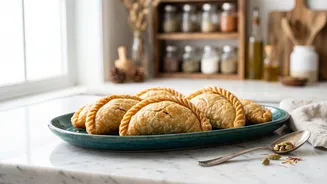






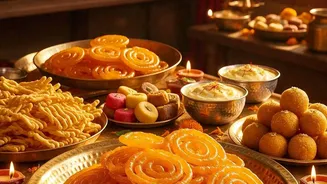
As Diwali approaches, the aroma of homemade sweets fills the air. Among the most cherished is the gujiya, a golden, crescent-shaped pastry with a crisp shell that gives way to a sweet, decadent filling. This is tradition in a single bite.
A Sweet Symbol of Celebration
Gujiya is more
than just a sweet; it's a taste of nostalgia and a beloved ritual of the festive season in India, especially during Diwali and Holi. This delightful pastry is essentially a sweet dumpling, made from a simple dough of all-purpose flour and ghee, which is then filled with a rich mixture and deep-fried to a perfect golden-brown. The result is a delightful contrast between the crunchy, flaky exterior and the soft, aromatic filling within. While known as gujiya in North India, it has counterparts across the country, such as karanji in Maharashtra, ghughra in Gujarat, and nevri in Goa, each with subtle variations but sharing the same festive spirit.
Gather Your Ingredients
This recipe focuses on the classic mawa (khoya) filling, which is rich and traditional. Precision is helpful, but cooking with heart is most important. For the dough you will need: 2 cups all-purpose flour (maida), 1/4 cup ghee (clarified butter), melted, and approximately 1/2 cup of water. For the filling, you will need: 1 cup crumbled mawa (khoya), 3/4 cup powdered sugar or to taste, 1/2 cup mixed nuts (like almonds, pistachios, cashews), finely chopped, 1/4 cup desiccated coconut, 1/2 teaspoon cardamom powder, and a pinch of nutmeg. You will also need ghee or oil for deep-frying.
Crafting the Perfect Crisp Shell
The secret to a fantastic gujiya lies in its shell. You want it to be crisp and flaky, not hard or chewy. Start by adding the 1/4 cup of melted ghee to the 2 cups of all-purpose flour in a large bowl. This step, called 'moyan', is crucial. Rub the ghee into the flour with your fingertips until the mixture resembles breadcrumbs. When you press a handful, it should hold its shape. This ensures a flaky texture. Now, begin adding water, a little at a time, and knead into a firm, but smooth dough. Do not make the dough too soft, as this will prevent it from becoming crispy. Cover the dough with a damp cloth and let it rest for at least 30 minutes. This resting period is essential for the gluten to relax, making the dough easier to roll.
While the dough is resting, prepare the filling. In a heavy_bottomed pan, lightly roast the crumbled mawa on low heat for a few minutes until it loosens up and releases a pleasant aroma. Be careful not to brown it. Transfer the roasted mawa to a bowl and let it cool down completely. Once cool, add the powdered sugar, chopped nuts, desiccated coconut, cardamom powder, and nutmeg. Mix everything together thoroughly. Your fragrant and delicious filling is now ready. Allowing the mawa to cool before adding sugar is important, as adding sugar to hot mawa will cause it to melt and make the filling runny.
After the dough has rested, divide it into small, equal_sized balls. Roll each ball into a thin circle, about '4 - '5 inches in diameter. Take a circle and place about a tablespoon of the filling on one half. Be careful not to overfill. Lightly moisten the edges of the circle with water using your fingertip. This will act as a glue. Fold the other half over to create a semi - circle , pressing the edges firmly to seal . You can use a fork to crimp the edges or create a traditional twisted pattern known as 'gothna'. You can also use a gujiya mould for a quick and uniform shape . Heat ghee or oil in a kadai or deep pan over medium - low heat . To check if the oil is ready , drop a tiny piece of dough into it ; it should sizzle and rise to the top slowly . Fry the gujiyas in small batches on low heat , flipping them occasionally , until they are golden brown and crisp on both sides . Frying on low heat is key to cooking them through and achieving that perfect crunch .
To ensure success , keep a few things in mind . First , ensure the dough is stiff ; a soft dough will result in soft gujiyas that soak up more oil . Second , the seal is everything . Make sure your gujiyas are sealed tightly to prevent the filling from spilling out into the oil , which can ruin the entire batch . Third , maintain a low frying temperature . High heat will brown the outside quickly while leaving the inside raw and the shell soft . Finally , let the fried gujiyas cool completely on a wire rack before storing them in an airtight container . They will continue to crisp up as they cool and can be stored at room temperature for up to two weeks .