
Listening to the Universe's Song
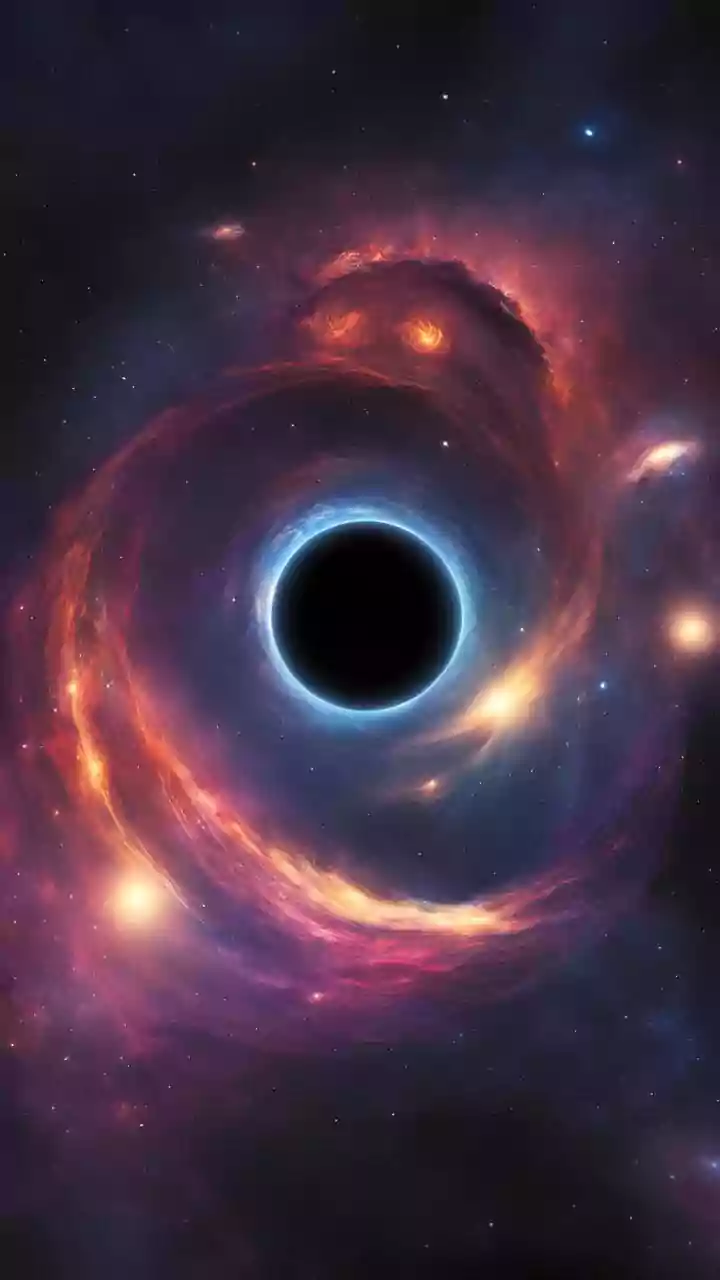
Imagine dropping a stone into a still pond. The ripples that spread across the water are similar to gravitational waves. These are invisible ripples in the very fabric of spacetime, created by the most cataclysmic events in the cosmos, like the collision
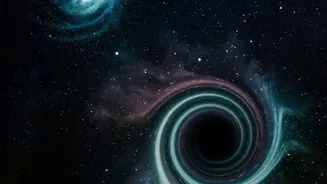
of black holes. First predicted by Albert Einstein, they were only directly detected in 2015. Observatories like the Laser Interferometer Gravitational-Wave Observatory (LIGO), Virgo in Italy, and KAGRA in Japan act as cosmic ears. They use incredibly precise lasers to sense these minuscule distortions in spacetime as they wash over Earth. Each detection is like hearing a new note in the universe's silent song, telling us a story about the violent, powerful processes that shape our cosmos.
The Cosmic Middle Child
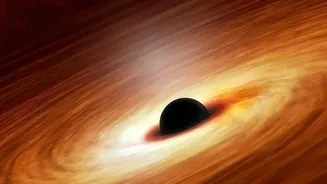
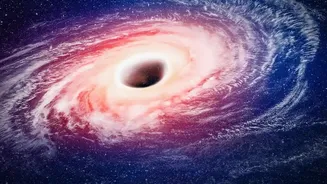
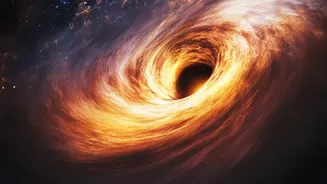
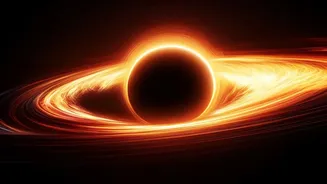
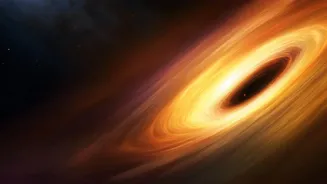
In the family of black holes, astronomers have long known about two main types: the small and the supermassive. Stellar-mass black holes, maybe up to 100 times the mass of our Sun, are born from the collapse of giant stars. At the other extreme are the supermassive black holes, millions or billions of times our Sun's mass, which sit at the heart of nearly every large galaxy, including our own Milky Way. For decades, there has been a puzzling gap between them. Where were the 'intermediate-mass' black holes (IMBHs), those with masses between 100 and 100,000 suns? Their existence has been a long-standing question, as they are too big to be formed from a single star's death but seem to lack a clear formation path like their supermassive cousins. Finding them is key to understanding the cosmic evolutionary ladder.
A Collision of Missing Links
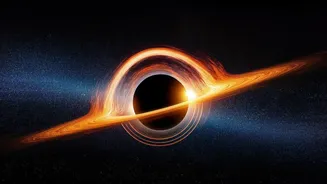
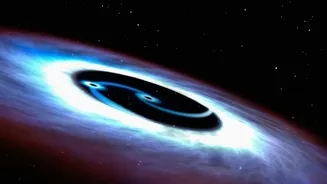
Recent announcements from the global network of gravitational wave observatories have provided the most compelling evidence yet for these cosmic middleweights. By analysing the ripples from distant mergers, scientists have identified collisions that could only have happened between two intermediate-mass black holes. One such event, GW231123, resulted from the merger of two black holes that created a new, larger one with a mass more than 225 times that of our sun. These detections are monumental because they not only confirm that IMBHs exist, but also that they can merge. Each merger sends out powerful gravitational waves and results in an even larger black hole, providing a tangible clue about cosmic growth.
The Seeds of Galactic Monsters
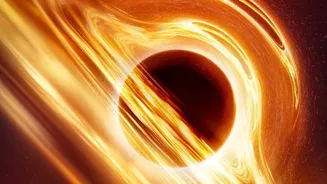
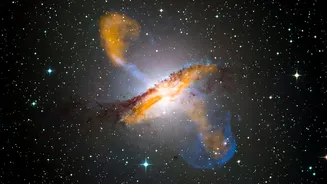
The discovery of IMBH mergers provides strong support for a major theory of galaxy formation: hierarchical growth. The idea is that the supermassive black holes at the centre of galaxies didn't just appear fully formed. Instead, they grew over billions of years, starting from smaller 'seeds'. These seeds could be intermediate-mass black holes, which formed in the dense star clusters of young galaxies. Over cosmic time, these IMBHs would sink to the centre of the galaxy, capturing other stars and, crucially, merging with other black holes. Each merger adds mass, building the black hole up from an intermediate size to a supermassive one. Observing these IMBH mergers is like watching the construction process in action, confirming that galaxies and their central black holes grow together.
A New Chapter in Astronomy
We are entering a golden age of gravitational wave astronomy. With each observing run, the detectors become more sensitive, able to listen for fainter and more distant collisions. The latest catalogue from the LIGO-Virgo-KAGRA collaboration has nearly doubled the number of known gravitational wave events, giving scientists a rich dataset to study how black holes form and interact. These observations are doing more than just filling a gap in our knowledge of black holes; they are providing a new way to measure the expansion of the universe and test the fundamental laws of physics. By listening to these ancient collisions, we are piecing together the history of how the grand structures of the universe were assembled, one black hole merger at a time.