



What Exactly Is a Planetary Alignment?
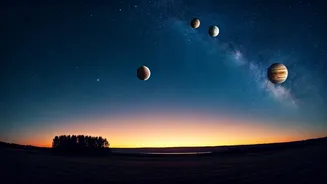
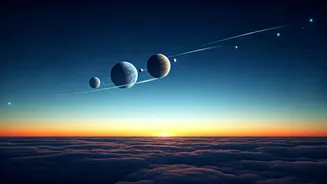
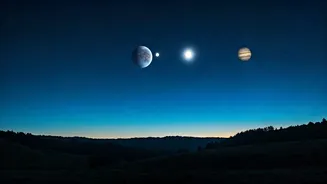
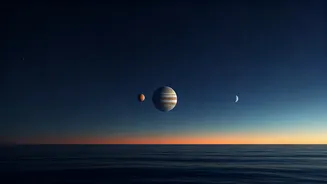
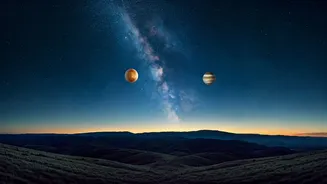
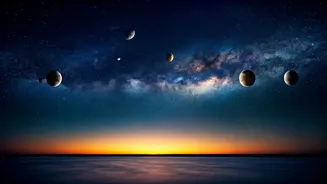
When we hear “planetary alignment,” it’s easy to imagine planets forming a perfectly straight line in space. The reality is a little different, but no less spectacular. An alignment, or conjunction, is an event where two or more planets appear close together
in the sky from our vantage point on Earth. They aren't actually close to each other in space—they are still millions of kilometres apart, following their own orbits around the sun. This is a line-of-sight illusion. Think of it like seeing two distant streetlights appear to be side-by-side, even though one might be a block further away than the other. For sky-gazers, these events are exciting because they offer a chance to see multiple planets in a small patch of sky, often with just the naked eye.
When and Where to Look From India
The best time to view this planetary gathering is shortly after sunset. You’ll want to start looking about 30 to 45 minutes after the sun has dipped below the horizon. The key is to find a clear view of the western sky, as the planets will be relatively low. The viewing window is short—these celestial bodies will follow the sun and set within about an hour or two. This isn't a middle-of-the-night event. Be ready as dusk settles in. For those in major Indian cities like Delhi, Mumbai, or Bengaluru, finding an unobstructed horizon away from tall buildings will be your biggest challenge. A rooftop terrace, a park, or the edge of the city will offer the best views.
How to Identify Each Planet
Spotting the planets is easier than you might think, as they don't twinkle like stars do. They shine with a steady, solid light.
**Venus:** This will be the easiest to find. Venus is the brightest object in the night sky after the Moon. It will appear as a brilliant, unblinking “evening star.” You can’t miss it.
**Jupiter:** The second brightest of the trio will be Jupiter. The king of planets will appear as a very bright, steady point of light, typically located near Venus during such alignments. Its brightness makes it stand out clearly from the surrounding stars.
**Mercury:** This is the trickiest one. Mercury is the smallest and faintest of the three, and it’s always close to the sun, so it gets lost in the twilight glow. Look for a faint, star-like point of light very close to the horizon, usually below the much brighter Jupiter and Venus. As the sky darkens, Mercury will become slightly more visible before it sets.
Do You Need a Telescope or Binoculars?
The good news is that you don't need any special equipment to see this alignment. Both Venus and Jupiter are bright enough to be easily seen with the naked eye, even from moderately light-polluted areas. However, a pair of binoculars will significantly enhance your experience. Through binoculars, the planets will appear as clear, sharp discs of light rather than just points. They can also be a lifesaver for spotting the elusive Mercury, helping you pick its faint glow out from the evening twilight. If you happen to have a small telescope, you might even be able to spot Jupiter's four largest moons—Io, Europa, Ganymede, and Callisto—appearing as tiny pinpricks of light flanking the planet.
Tips for the Best Viewing Experience
To make the most of this celestial show, a little preparation goes a long way. First, get away from direct city lights if you can. Even moving to a local park or a darker street can make a difference. Second, give your eyes time to adapt to the dark. It takes about 15-20 minutes for your pupils to fully dilate, which will help you spot fainter objects like Mercury. Avoid looking at your phone screen, as its bright light will ruin your night vision. If you need a light, use a red torch or a phone app with a red-light filter. Finally, be patient. Take a moment, get comfortable, and just enjoy the view. It’s a beautiful reminder of the vast solar system we are a part of.