







Vrikshasana, or Tree Pose, is more than a test of balance; it's a practice of grounding and focus. The secret to unlocking its steady power and exploring its many variations lies not just in your feet, but in your eyes.
The Secret to Stability: Your Drishti
In yoga, the term 'drishti' refers
to a focused gaze, a specific point you rest your eyes on to minimize distractions and cultivate concentration. For balancing poses like Tree Pose, it is a non-negotiable tool. When your eyes wander, your body follows, leading to wobbles. By fixing your gaze on a single, unmoving point at eye level—a spot on the wall, not a window or another person—you give your brain a stable reference point. This simple act calms the mind, encourages steady breathing, and provides the anchor needed to keep your body stable as it makes tiny, constant adjustments to maintain equilibrium.
Building Your Foundation: The Basic Pose
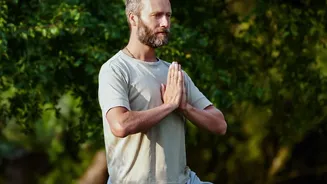
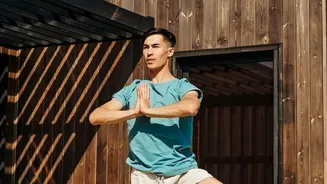
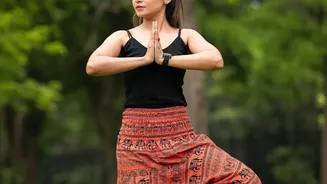
Before you can grow branches, you must establish strong roots. Start in Mountain Pose (Tadasana), with your weight distributed evenly. Shift your weight onto one foot, keeping the standing knee slightly soft, never locked. Bend the other knee and place the sole of your foot on your inner ankle, calf, or inner thigh. The most critical rule is to never place your foot directly on the knee joint, as this puts harmful pressure on it. Bring your hands to a prayer position at your chest. Actively press the foot into the leg and the leg into the foot to create stabilizing tension. Find your drishti, hold your gaze, and breathe.
Beginner Modifications to Find Your Balance
If you feel unsteady, there are many ways to build confidence. The 'kickstand' variation involves keeping the toes of your lifted foot on the floor while the heel rests against the standing ankle. This provides support while you practice alignment. You can also practice near a wall, using it for a light touch if you start to sway. Another option is to keep your hands on your hips, which can sometimes feel more grounding than bringing them to your chest. The goal is not to achieve the full expression of the pose immediately, but to build a stable foundation with patience. Wobbling is part of the process; it means your body is learning to balance.
Growing Your Branches: Intermediate Variations
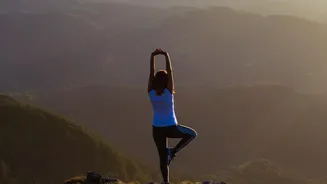
Once your foundation feels solid and your gaze is steady, you can begin to explore. From the basic pose, inhale and extend your arms overhead like branches reaching for the sun. You can keep them shoulder-width apart or press the palms together. For another variation, try a gentle side bend by lowering one arm and reaching the other up and over, creating a 'swaying tree' effect. This introduces gentle movement that challenges your core and standing leg to work harder to maintain your center. Throughout these variations, your drishti remains your anchor, allowing you to move with control rather than instability.
Challenging Your Roots: Advanced Practice
For a deeper challenge, you can move toward Half-Lotus Tree Pose (Ardha Padmasana in Vrikshasana) by placing the top of your lifted foot onto the opposite hip crease. This is an intense hip opener that requires significant flexibility. The ultimate test of proprioception—your body’s sense of its position in space—is to briefly close your eyes. By removing your visual reference point, you force your body to rely entirely on internal balance. This should be attempted only when you feel very stable, perhaps near a wall for safety. These advanced stages show how mastery in Tree Pose is an internal journey of focus and awareness.