




The Invisible Backbone of Modern India
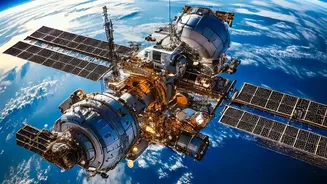
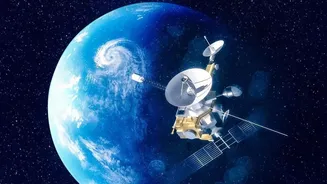
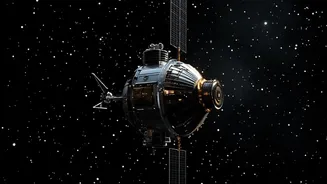
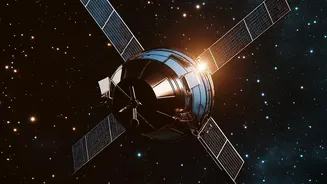
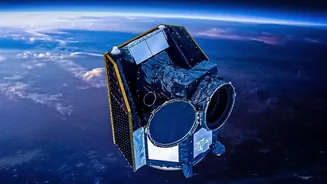
We rarely think about them, but thousands of satellites orbiting Earth form the invisible backbone of our digital world. In India, this reliance is growing exponentially. The Digital India initiative, the new NavIC navigation system, and the expansion
of broadband to rural areas through projects like BharatNet all depend on a robust network of satellites. Our booming space economy, projected to hit $44 billion by 2033, is built on this foundation. From weather forecasting that protects farmers to secure communications for our defence forces, and even enabling millions of remote workers, satellites are no longer a futuristic luxury; they are critical national infrastructure. This increasing dependence, however, comes with a significant and often invisible risk. As companies like Reliance Jio and Bharti Airtel's OneWeb plan vast new satellite constellations, ensuring their safety becomes paramount.
A Storm Brewing in Space
The threat comes not from rivals on Earth, but from our own sun. The sun constantly emits a stream of charged particles called solar wind. Most of the time, Earth's magnetic field protects us. But sometimes, the sun unleashes massive eruptions of energy and matter, known as solar flares and Coronal Mass Ejections (CMEs). When these storms of high-energy particles hit Earth, they can wreak havoc on our technology. For satellites, the danger is multi-faceted. The particles can damage sensitive electronics, cause phantom commands, or degrade solar panels. Geomagnetic storms can also heat and expand Earth's upper atmosphere, increasing drag on low-orbit satellites and causing them to burn precious fuel to stay in orbit, or even fall back to Earth. Furthermore, these storms disrupt the very radio signals satellites use to communicate, affecting everything from GPS accuracy to broadcast signals.
Forecasting the Final Frontier
For decades, predicting this 'space weather' has been a major challenge. Current systems, which rely on spacecraft like the DSCOVR satellite, often provide only 15 to 30 minutes of warning before a CME hits—not enough time to take meaningful action. This is where 'smarter forecasts' come in. Researchers are now turning to Artificial Intelligence (AI) and machine learning to create faster, more accurate prediction models. By training AI on vast amounts of data from solar observatories, scientists can teach it to recognise the complex patterns that precede a solar flare or CME. New projects led by institutions like NASA and ESA aim to improve these models further. Some researchers are developing AI that can analyse solar images and magnetic field data to predict flares with greater precision. Others are working on new instruments, like the UK's MAGIC magnetometer, which will be placed much farther from Earth to provide several hours of advance warning, rather than minutes.
The Future of Secure Skies
The goal of these smarter forecasts is simple: to give satellite operators enough time to act. With a few hours' warning, operators can put sensitive systems into a safe mode, re-route data traffic, or even adjust a satellite's orbit to mitigate damage. This could prevent the loss of multi-crore assets and, more importantly, avoid widespread disruptions to communication, navigation, and financial systems on the ground. As India prepares to launch hundreds of new satellites in the coming years, integrating these advanced forecasting capabilities will be crucial for protecting our investment and ensuring the resilience of our digital infrastructure. The research represents a fundamental shift from simply bracing for impact to proactively managing the risks of living in a solar system with an active star. By understanding the sun's behaviour better, we can ensure our technological ambitions are not derailed by a celestial storm.