





The Tipping Point: Reusable Rockets
For decades, space was the exclusive domain of global superpowers, primarily because getting there was astronomically expensive. Every mission required a new, custom-built rocket that would be discarded after a single use. That all changed with the perfection
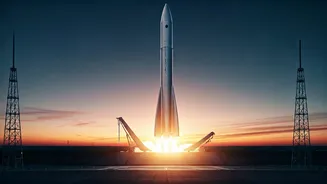
of reusable rockets, most famously pioneered by SpaceX. By designing rockets that can return to Earth, land themselves, and be prepared for another flight, the cost of reaching orbit has plummeted. Where prices once exceeded $10,000 per kilogram, they have dropped dramatically, with the potential to fall below $100 per kilogram in the near future. This radical cost reduction is the engine driving the entire private space revolution; it makes everything else—from satellite mega-constellations to commercial space stations—economically viable for the first time in history.
More Than Rockets: The Satellite Boom
With launch costs falling, the floodgates have opened for a new generation of satellite-based businesses. Companies are no longer launching single, school-bus-sized satellites but deploying vast constellations of smaller, interconnected ones. These networks are revolutionising global communications, providing high-speed internet to remote corners of the globe through services like SpaceX's Starlink and Amazon's competing Project Kuiper. Beyond connectivity, this satellite boom powers a massive data economy, offering real-time Earth observation for everything from climate monitoring and disaster response to agricultural management. This shift transforms space from a place to visit into a utility that provides critical services and recurring revenue streams back on Earth.
The Next Frontier: Commercial Space Stations
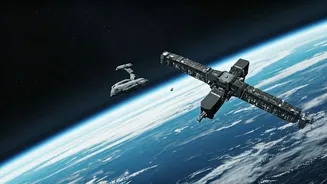
The International Space Station (ISS), humanity's orbital home for over two decades, is scheduled for retirement around 2030. Instead of building a replacement, NASA is turning to the private sector, planning to become a customer on commercially owned and operated space stations. Several companies, including Axiom Space, Blue Origin with its Sierra Space partnership on Orbital Reef, and Vast, are in a race to build these new orbital outposts. Vast's Haven-1 is targeting a launch as early as 2027 to become the first standalone commercial station. These platforms will serve as hubs for in-space research, advanced manufacturing of materials like semiconductors and pharmaceuticals, and, of course, tourism. This marks a fundamental transition from a single government-run outpost to a competitive marketplace in low-Earth orbit.
An Industry Taking Flight: Tourism and Beyond
While still in its early days, space tourism is evolving from a novelty into a functioning business. Suborbital flights offering a few minutes of weightlessness are becoming more regular. The global space tourism market is projected to grow significantly, from around $8.9 billion in 2026 to over $62 billion by 2036, according to some market analyses. While orbital trips remain exceptionally expensive, costs are expected to decline as technology matures. More importantly, the development of tourism infrastructure is a stepping stone. On June 23, 2026, SpaceX launched a reusable capsule as part of a new program to explore in-space manufacturing, demonstrating how capabilities developed for human spaceflight can be leveraged for other commercial ventures like producing unique materials in microgravity.
India's Ascent in the New Space Race
This revolution is not limited to the West. India's space sector is experiencing explosive growth, transforming from a government-led program into a dynamic ecosystem of private innovation. Spurred by the Indian government's establishment of IN-SPACe, a single-window agency to promote private participation, the number of Indian space startups has surged from just one in 2014 to over 400 by 2024. Companies like Skyroot Aerospace, which launched India's first private rocket, and Agnikul Cosmos, which is 3D-printing engines, are at the forefront. With a space economy projected to grow from around $8 billion to over $40 billion by the early 2030s, India is positioning itself not just as a participant but as a major global hub for space commerce.