




A Pathfinder's Job Is Done
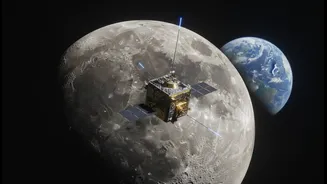
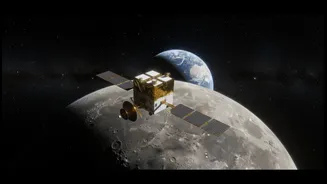
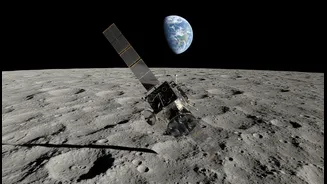
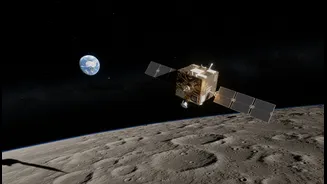
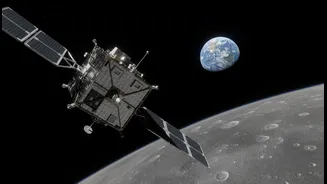
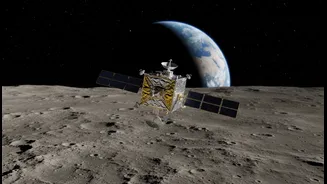
In early July 2026, NASA officially concluded its activities with the CAPSTONE mission, nearly four years after its launch in June 2022. The small, 25-kg CubeSat achieved all of its primary and extended goals. Its main purpose was to be a pathfinder,
the first spacecraft to ever enter and operate in a unique and highly efficient lunar path known as a Near-Rectilinear Halo Orbit (NRHO). The mission successfully verified that this orbit is as stable and fuel-efficient as models predicted, a crucial step for future long-term missions around the Moon. Additionally, CAPSTONE tested innovative autonomous navigation technology, proving a spacecraft could determine its position by communicating with another orbiter—in this case, NASA's Lunar Reconnaissance Orbiter—without constant guidance from Earth. Having passed these critical tests, the mission has been hailed as a resounding success, providing vital data for the Artemis program.
The Station Confusion
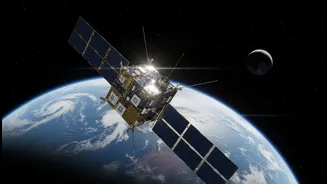
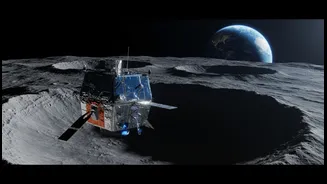
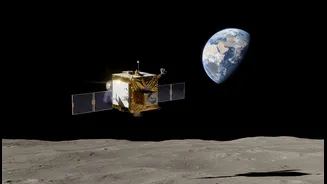
Despite its success, CAPSTONE's role is frequently misunderstood. It is often mistaken for a precursor to or even a component of the Lunar Gateway, the planned space station in lunar orbit. This confusion is understandable, as CAPSTONE's entire mission was to test the very orbit and technologies intended for Gateway. However, to put it simply, CAPSTONE was the scout, not the fortress. The Lunar Gateway is envisioned as a multi-module habitat and research outpost, a staging point for missions to the lunar surface. CAPSTONE, by contrast, is a tiny, single-piece spacecraft about the size of a microwave oven. Its job was never to host astronauts or conduct long-term science, but to prove that the foundational concepts for a lunar station were sound.
Test vs. Habitation: A Tale of Two Missions
The difference between a technology demonstrator like CAPSTONE and a space station like Gateway is immense, covering purpose, scale, and complexity. CAPSTONE was designed as a low-cost, rapid mission to answer a few key questions: Does the NRHO work as expected? Can a spacecraft navigate itself in deep space? It was a focused, surgical test. The Lunar Gateway, on the other hand, represents a permanent piece of infrastructure. It is designed for longevity, expandability, and human habitation, involving multiple international partners and numerous launches to assemble its various modules. While CAPSTONE's mission cost is measured in the tens of millions, a station like Gateway is a multi-billion dollar, decades-long endeavor. One is a question, the other is an answer. One charts the path, the other builds the city.
The Groundbreaking NRHO Orbit
At the heart of the mission is the Near-Rectilinear Halo Orbit itself. Unlike the relatively simple, circular orbits we see around Earth, the NRHO is a highly elongated, seven-day loop around the Moon. It exists at a precise balance point between the gravity of the Earth and the Moon, which makes it remarkably stable and requires very little fuel for a spacecraft to maintain its position. This makes it an ideal staging area for a future station. From this orbit, a spacecraft has a constant line of sight to Earth for communications and can easily access any part of the lunar surface, including the resource-rich polar regions. Before CAPSTONE, the stability of this orbit was only theoretical. By flying in it for over a year, CAPSTONE proved that the complex gravitational dance was not just possible, but practical.
Why the Distinction Matters
Understanding the difference between CAPSTONE and a full-fledged station is key to appreciating how space exploration actually works. Progress is not made in giant leaps, but through a series of careful, incremental steps. Every major project, from the International Space Station to India's own Chandrayaan missions, relies on smaller, preceding missions to test technologies and reduce risk. CAPSTONE is a perfect example of this vital, if less glamorous, work. It successfully retired major risks for the Artemis program and paved the way for a permanent human presence around the Moon. By celebrating CAPSTONE for what it is—a brilliant, successful pathfinder—we get a clearer picture of the steady, methodical engineering that will carry humanity back to the Moon and beyond.