



Meet the Cosmic Time Machine
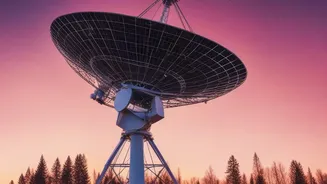
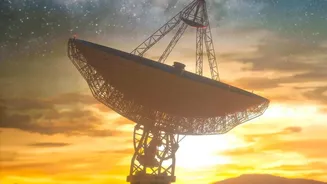
Deep in a radio-quiet valley in British Columbia, Canada, sits a telescope that looks nothing like a conventional satellite dish. The Canadian Hydrogen Intensity Mapping Experiment, or CHIME, is composed of four massive, stationary half-pipe cylinders,
each 100 metres long. It has no moving parts. Instead of pointing and tracking objects, CHIME lets the Earth's rotation do the work, scanning a huge strip of the northern sky every single day. This unique design allows it to survey a larger volume of the universe than any telescope before it, effectively creating a massive, four-dimensional map of space and time. Built by a consortium of Canadian universities, CHIME is a testament to innovative, cost-effective design, using consumer technology like powerful video game processors to handle an astonishing amount of data.
The Whisper of Ancient Hydrogen
CHIME's primary target is one of the most elusive signals in the cosmos: the '21-centimetre line'. This is a faint radio wave naturally emitted by neutral hydrogen, the most abundant element and the raw material that formed the first stars and galaxies. This signal acts as a cosmic tracer, revealing how matter was distributed billions of years ago. However, because the universe has been expanding for 13.8 billion years, these ancient radio waves get stretched out on their long journey to us. A signal that started as a 21-centimetre wavelength arrives at CHIME as a much longer wave. By tuning into a specific frequency range—400 to 800 MHz—CHIME can effectively look back in time to a period when the universe was between 2.5 and 7 billion years old.
The Art of Intensity Mapping
Trying to see individual clouds of ancient hydrogen is impossible; they are far too faint. This is where CHIME's genius method comes in. Instead of trying to create a sharp picture, it uses a technique called Hydrogen Intensity Mapping. Rather than resolving individual galaxies, CHIME measures the collective glow, or intensity, of all the hydrogen in huge patches of the sky. By mapping where this glow is slightly brighter or dimmer, it creates a coarse, three-dimensional map of large-scale structures in the universe. This statistical approach allows scientists to trace the cosmic web without needing to pinpoint single galaxies, a breakthrough that makes mapping the universe faster and much less expensive than traditional optical surveys.
Finding a Needle in a Cosmic Haystack
Detecting this faint, ancient signal is an immense technical challenge. The radio glow from neutral hydrogen is billions of times weaker than other radio signals coming from our own galaxy and from human-made sources on Earth, like TV broadcasts and mobile phones. These brighter signals create a 'foreground' of noise that threatens to completely overwhelm the whisper from the early universe. For years, the main challenge for the CHIME team has been to develop sophisticated data processing and calibration techniques to meticulously subtract this noise. Recently, in a milestone achievement, researchers announced they had successfully detected the hydrogen signal using only CHIME's own data, a process known as auto-correlation. This proves the technique works and solidifies CHIME's role as a revolutionary cosmological tool.
Why This Cosmic Map Matters
So, why go to all this trouble to map ancient hydrogen? The answer lies in one of the biggest mysteries in physics: dark energy. Scientists know the universe's expansion is accelerating, and they attribute this to a mysterious force called dark energy, but its nature remains unknown. The large-scale structures CHIME maps contain imprints of sound waves, known as Baryon Acoustic Oscillations (BAO), that rippled through the early universe. These imprints serve as a 'standard ruler' for cosmologists. By measuring the size of this ruler at different points in cosmic history, scientists can track the expansion rate of the universe with incredible precision. This will help them test theories about dark energy and create our most detailed history of the cosmos yet.