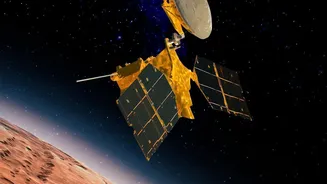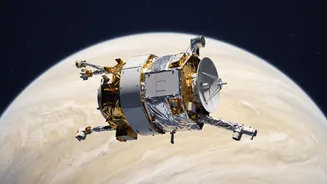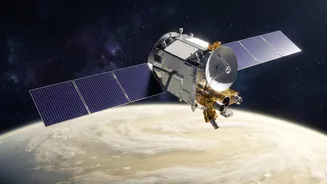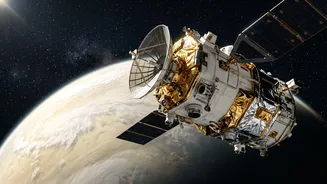



What is the Shukrayaan Mission?
Shukrayaan-1, which translates to "Venus Craft," is the Indian Space Research Organisation's (ISRO) next major interplanetary expedition following the successes of Chandrayaan to the Moon and Mangalyaan to Mars. Approved by the government in September
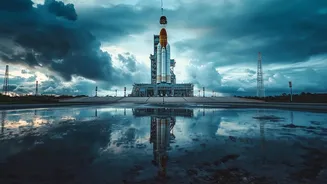
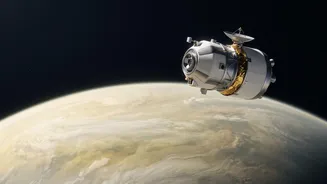
2024, this orbiter mission is designed to conduct a comprehensive study of Venus from above. Scheduled for a launch aboard the powerful LVM-3 rocket on March 29, 2028, the spacecraft will embark on a 112-day journey to enter an elliptical orbit around the planet. Unlike missions that land on the surface, Shukrayaan will circle Venus for over four years, using a suite of advanced instruments to peer through its dense atmosphere and map its hidden surface. The mission represents a major step for India, positioning it as a key player in global planetary science.
The Enigma of Venus's Atmosphere
Venus is often called Earth's "evil twin." It’s similar in size and mass, but its evolution took a dramatically different path. Today, it is the hottest planet in our solar system, with surface temperatures that can melt lead and an atmospheric pressure 90 times that of Earth's. The planet is perpetually shrouded in thick clouds of sulfuric acid, which race around the planet in a phenomenon known as "super-rotation," where winds move faster than the planet itself spins. For decades, scientists have been fascinated by this extreme environment. Understanding why Venus became a runaway greenhouse world is crucial for learning more about planetary climate evolution, including the potential future of our own planet. The mission aims to analyze this dense atmosphere, its composition, and its complex dynamics.
Sensors to Uncover Chemical Secrets
The core of the Shukrayaan mission lies in its sophisticated payload of scientific instruments, designed to analyse the planet from its ionosphere down to its sub-surface. The headline-making aspect is the focus on atmospheric chemistry. The spacecraft will carry instruments like a thermal camera and cloud monitoring tools to study the structure and movement of the Venusian clouds. One key instrument, the Venusian Neutrals Analyser (VNA), is being developed in collaboration with Sweden's Institute of Space Physics. The VNA will study how charged particles from the sun interact with Venus's atmosphere, helping to explain how the planet lost its water and became so inhospitable. Other instruments, including a mass spectrometer, will directly measure the composition of the atmosphere, providing crucial data on the gases and chemical processes at play beneath the opaque cloud tops.
The Search for Answers and Active Volcanoes
Beyond the clouds, Shukrayaan has other groundbreaking objectives. It will carry a high-resolution Synthetic Aperture Radar (SAR) to map the planet’s surface with four times the detail of NASA's Magellan mission from the 1990s. This will help scientists identify volcanic hotspots and fresh lava flows, potentially confirming if Venus is still geologically active. Even more uniquely, the mission will feature a ground-penetrating radar—a world-first for Venus exploration. This instrument will allow ISRO to peer several metres below the surface, investigating the planet's subsurface geology and stratigraphy for the first time in history. This multi-faceted approach, combining atmospheric, surface, and sub-surface studies, makes Shukrayaan one of the most comprehensive Venus missions ever planned.
India's Next Interplanetary Frontier
Shukrayaan solidifies India's role as a formidable force in space exploration. Building on the cost-effective and highly successful Mangalyaan mission, ISRO is leveraging international partnerships with countries like Sweden, Russia, and Germany to enhance the mission's scientific output. These collaborations not only bring in advanced technology and shared expertise but also reduce overall costs, reinforcing ISRO’s reputation for frugal innovation. The mission is not just a scientific endeavour; it's a statement of intent. As India sets its sights on future milestones like putting an astronaut on the Moon by 2040 and establishing a space station by 2035, missions like Shukrayaan serve as crucial building blocks, testing advanced technologies like aerobraking and demonstrating the nation's capability to undertake complex deep-space operations.