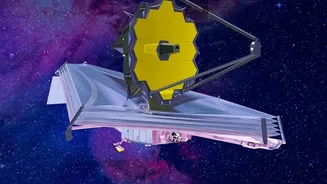


Our Golden Eye on the Cosmos
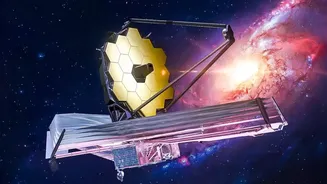
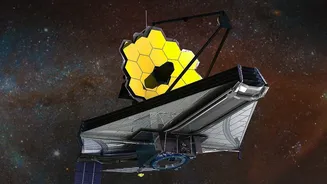
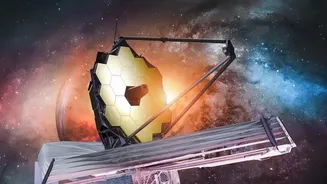
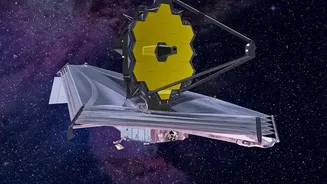
Since its launch, the James Webb Space Telescope has been rewriting our understanding of the universe, peering back to the dawn of time and capturing images of galaxies never before seen. But its primary mission is arguably even more profound: to study
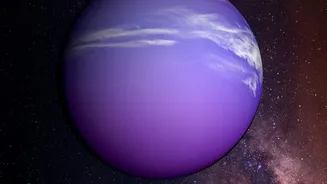
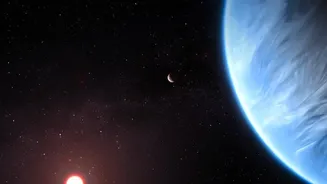
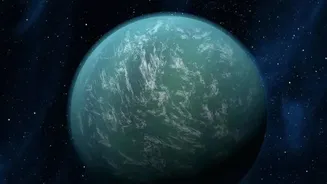
exoplanets, worlds orbiting other stars. The ultimate goal is to find one like Earth. To do this, JWST is equipped with some of the most advanced scientific instruments ever built. These tools don't just take pictures; they dissect the light from distant stars to uncover the secrets of the planets that orbit them. It's less about seeing these planets and more about tasting their atmospheres from light-years away.
How to Analyse an Alien Atmosphere
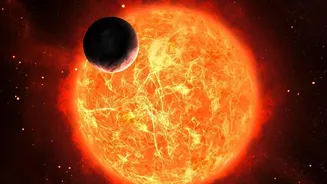
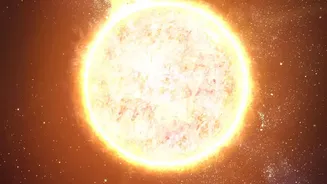
Detecting what an exoplanet’s atmosphere is made of is a monumental challenge. These planets are incredibly faint and far away, completely washed out by the glare of their parent stars. Scientists use a clever trick called transit spectroscopy. When a planet passes in front of its star from our perspective, a tiny fraction of the starlight filters through the planet's atmosphere. Different gases in that atmosphere absorb specific colours, or wavelengths, of light. By looking at which colours are missing from the starlight after it passes through, astronomers can determine what chemicals are present. Before Webb, our ability to read these signals was often hampered by things like high-altitude haze on these planets, which would block the light and give a flat, unreadable result.
Decoding the Barcode of Light
The missing colours in the starlight are known as 'spectral lines'. Think of them as a unique barcode for every chemical element and compound. Water vapour, methane, carbon dioxide—each one casts a distinct shadow on the spectrum of light. The JWST’s breakthrough is not just that it can see this barcode, but the incredible precision with which it can read it. Its sensitive infrared instruments, like the Near-Infrared Spectrograph (NIRSpec) and Mid-Infrared Instrument (MIRI), can capture these faint spectral lines with unprecedented clarity. This allows scientists to identify molecules that were previously too difficult to spot and to do so for smaller planets than ever before.
The Breakthrough Sensor Technology
The 'breakthrough' in the headline refers to the superior resolving power and sensitivity of JWST's instruments. While previous telescopes like Hubble could detect some atmospheric components on giant planets, JWST's technology represents a quantum leap. Its ability to separate individual spectral lines that were previously blurred together allows for more confident detections of water and other molecules. For example, on ultra-hot gas giants where water molecules are being torn apart by heat, Webb can still detect the subtle signature of the water that remains. This precision is the new 'sensor technology' that's changing the game; it’s not a single new gadget, but the enhanced capability of the entire telescope system, which can now perform detailed chemical analysis on a wider range of planets, including rocky ones.
A Watery Signature, 370 Light-Years Away
One of the most exciting recent findings using this technology comes from the PDS 70 system, about 370 light-years away. There, JWST detected water vapour in the inner disk of the system, the very region where rocky, Earth-like planets are thought to form. This is the first time water has been detected so close to a star in a system already known to be building planets. It suggests that the raw ingredients for life, at least as we know it, could be available to these worlds from the very beginning of their formation. While this isn't an atmosphere on a finished planet, it's a look into the planetary nursery, showing the water is there and ready to be incorporated.
The First Step on a Long Journey
Finding water vapour is a crucial milestone, but it's only the first step. The presence of water alone doesn't mean a planet is habitable, let alone inhabited. The true power of Webb's technology lies in its potential to find 'biosignatures'—combinations of gases that are unlikely to exist without the presence of life. Scientists will now use this enhanced ability to look for not just water, but also for telling combinations of methane, oxygen, and carbon dioxide. This breakthrough in detecting spectral lines is what moves the search for extraterrestrial life from the realm of science fiction into a tangible, data-driven scientific quest.