







The Planet’s Giant Mirror
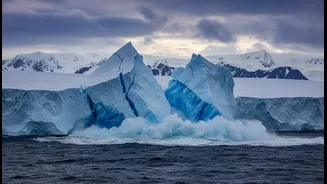
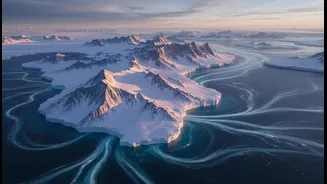
One of Antarctica's most significant roles is acting as a giant mirror. The continent is covered by an enormous ice sheet, and its bright white surface has a high albedo, meaning it reflects a large amount of solar radiation back into space. This helps
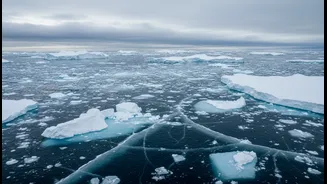
to keep the entire planet cooler. Darker surfaces, like open ocean or land, absorb more heat. As long as the ice sheet remains stable, it performs this vital cooling service. However, as global temperatures rise, any melting can expose darker water or land underneath, which absorbs more heat and creates a feedback loop that accelerates warming.
Driving the Global Ocean Conveyor Belt
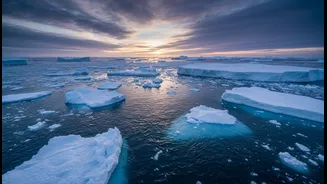
Antarctica is the birthplace of the world's coldest, densest saltwater. As seawater freezes around the continent, it expels salt, making the remaining unfrozen water extremely salty and heavy. This frigid, dense water sinks to the ocean floor, kicking off a process known as the 'global conveyor belt' or thermohaline circulation. This deep, slow-moving current transports heat, carbon, and nutrients around the globe, connecting the Atlantic, Pacific, and Indian oceans. This circulation is crucial for regulating global temperatures and distributing nutrients that support marine ecosystems worldwide. Scientists are concerned that melting glaciers are flushing fresh, less dense water into the system, which could weaken this critical 'ocean pump'.
A Crucial Carbon Sink
The Southern Ocean, which encircles Antarctica, is one of the most important carbon sinks on the planet. It is estimated to absorb about 40% of the carbon dioxide (CO2) generated by human activities and up to 90% of the excess heat trapped by greenhouse gases. This process is largely driven by tiny marine organisms called phytoplankton. Through photosynthesis, they consume CO2 from the atmosphere. When they die, they sink, sequestering that carbon in the deep ocean. This natural service provides a massive buffer against the effects of climate change. Changes in ocean temperature and chemistry, however, could impact the efficiency of this vital carbon sink.
The Sea-Level Regulator
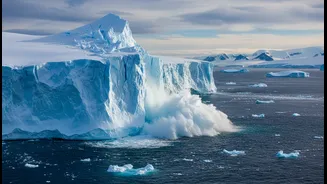
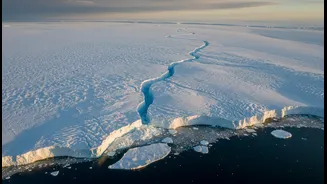
The Antarctic Ice Sheet holds about 90% of the world's fresh water. If it were to melt entirely, global sea levels would rise by a catastrophic 60 metres (around 200 feet). While a complete melt is not imminent, the ice sheet is already losing mass at an accelerating rate, currently shedding around 150 billion tons of ice per year. This meltwater is a significant contributor to global sea-level rise, which poses a direct threat to coastal communities around the world, including India's densely populated coastline. Even a modest rise in sea level can lead to more severe storm surges, contamination of freshwater sources, and the displacement of millions of people.
Links to India’s Climate
What happens in Antarctica does not stay in Antarctica. Research has established teleconnections, or long-distance links, between the polar regions and India’s climate. Changes in Antarctic sea ice, for example, have been shown to influence large-scale atmospheric circulation patterns like the Hadley and Ferrel cells. These shifts can, in turn, affect the strength and behaviour of the Indian summer monsoon, a system that is the lifeblood of the nation's agriculture and economy. As India's own scientists at the National Centre for Polar and Ocean Research (NCPOR) continue to study these connections, it's clear that the stability of the distant frozen continent is of immense importance to India's future.