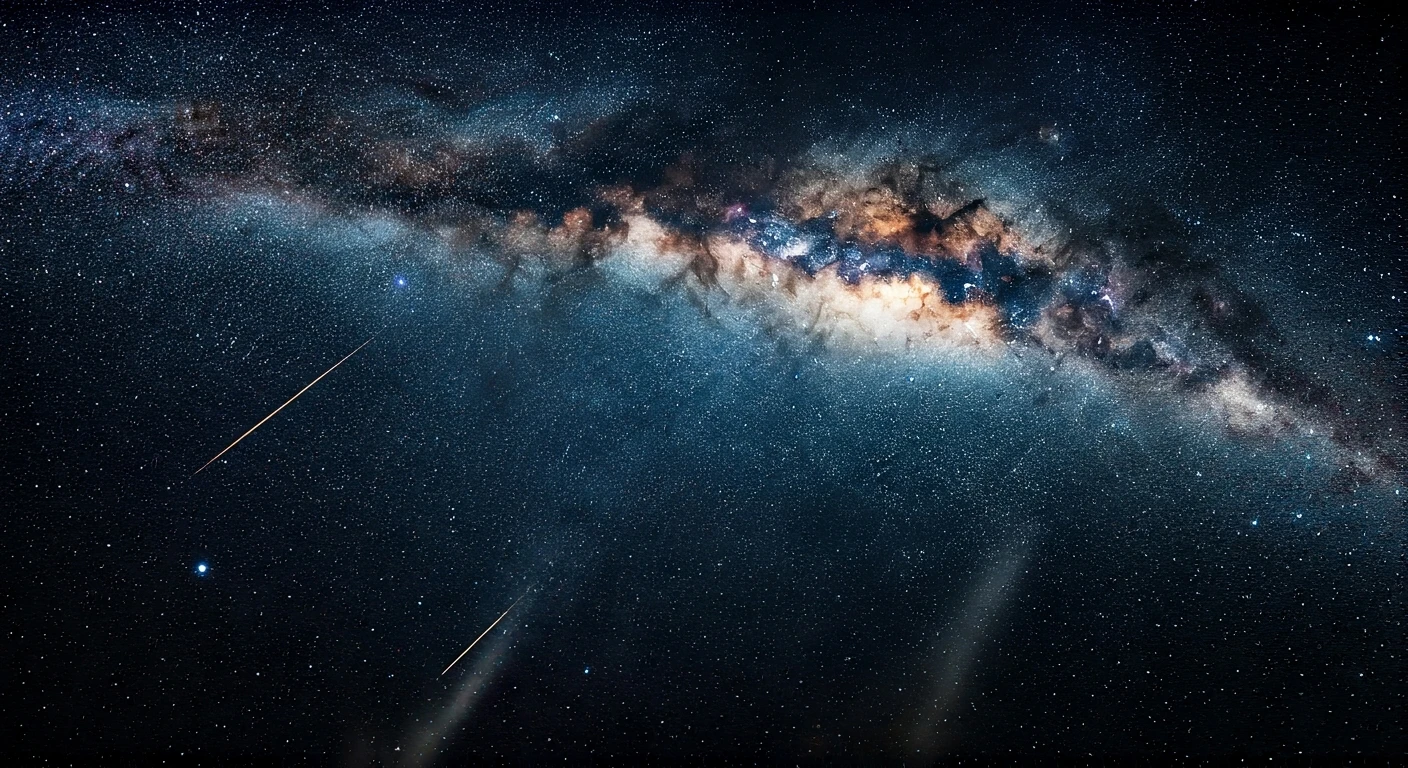



A Cosmic Time Machine
It sounds like science fiction, but it’s one of the most fundamental truths of our universe. Nothing travels faster than light, but space is so mind-bogglingly vast that even at its blistering speed of nearly 300,000 kilometres per second, light takes
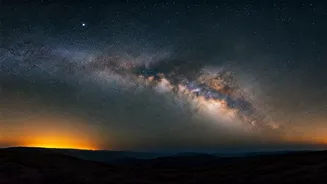
time to reach us. A lot of time. Astronomers measure these immense distances in light-years: the distance light travels in one year. So, when we say a star is 100 light-years away, we mean the light we see tonight began its journey 100 years ago. In essence, every telescope is a time machine, and every glance at the night sky is a look back into history.
Our Nearest Neighbours
Let’s start close to home. The closest star to our Sun, Proxima Centauri, is about 4.2 light-years away. The light you see from it isn’t from last night; it’s from over four years ago. It left the star’s surface around the time India was launching its Mars Orbiter Mission. Sirius, the brightest star in our night sky, is about 8.6 light-years away. The faint twinkle you see from your balcony in Delhi or Mumbai is light that started its journey when the first iPhone was just being released. These stars are our immediate cosmic neighbourhood, yet we are still seeing them as they were in the recent past, not the present.
A Glimpse into History
This is where the headline’s promise truly shines. Many of the stars we can see with the naked eye are hundreds of light-years away. Take Polaris, the North Star, which has guided travellers for generations. It sits roughly 430 light-years from Earth. This means the light we see from Polaris tonight started its journey around the year 1594. While the Mughal emperor Akbar was reigning over much of the Indian subcontinent and Shakespeare was writing his first plays in England, this light was just beginning its long voyage across the cosmos. When you look at Polaris, you are seeing a photon that is older than the Taj Mahal.
Ghosts in the Sky?
The concept gets even more dramatic with older, more volatile stars. Consider Betelgeuse, the bright red-orange star in the shoulder of the constellation Orion. It’s a red supergiant about 640 light-years away. Scientists know that Betelgeuse is nearing the end of its life and will explode in a spectacular supernova. The fascinating part? It might have already happened. It could have exploded in the 14th century, and the news—travelling at the speed of light—simply hasn't reached us yet. We could wake up tomorrow to a new, incredibly bright object in our sky, the signal of a death that occurred centuries ago. For now, we continue to see a star that may no longer exist.
Beyond a Human Timescale
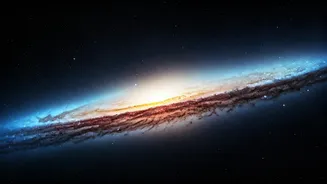
The scale escalates dramatically when we look beyond our own galaxy. On a very dark, clear night, you can spot a faint, fuzzy patch of light known as the Andromeda Galaxy. This is not a star, but a collection of a trillion stars, much like our own Milky Way. It is the most distant object visible to the naked eye, and it is 2.5 million light-years away. The light from Andromeda that reaches your eyes tonight is 2.5 million years old. It began its journey when our earliest human ancestors, like Homo habilis, were first walking the Earth. It has travelled through intergalactic space for eons, long before modern humans even existed, just to end its journey in your eye.