






The Chilling Problem with Quantum Tech
The promise of quantum technology — from ultra-powerful computers to unhackable communication networks — has always come with a significant catch: it needs to be cold. Extremely cold. Most quantum systems must be kept near absolute zero, or roughly -273
degrees Celsius. At normal temperatures, the world is a noisy place full of heat and vibration. This environmental 'noise' is enough to disrupt the fragile and delicate states of quantum mechanics, a process called decoherence. To prevent this, scientists use bulky, complex, and expensive cryogenic refrigeration systems. This has largely confined quantum breakthroughs to specialised labs, making real-world applications difficult and costly to deploy.
A Breakthrough Forged from Gold
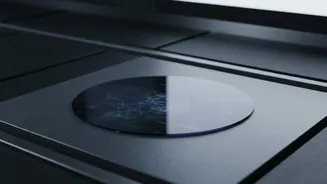
A recent announcement from researchers at Louisiana State University (LSU) details a new material that sidesteps this cooling requirement. In a study published in the journal Nature, scientists revealed a novel 'metacrystal' that can sort and transport different quantum states of light at room temperature. The material itself is a feat of nano-engineering. It was created by taking a thin film of gold on a glass chip and carving it with hundreds of microscopic slits using a focused ion beam. These tiny patterns act like artificial atoms, or 'meta-atoms'. Together, they form a unique crystal structure, thinner than a human hair, that has no natural counterpart. This artificial design is the key to its success, allowing it to manipulate quantum information without the thermal interference that plagues other systems.
Filtering Light, Not Electrons
So how does it work? The innovation lies in focusing on photons (particles of light) instead of electrons. Heat causes atoms to vibrate, which typically scrambles the quantum information carried by electrons. This new material, however, works by filtering light. As different quantum states of light pass over the gold metacrystal, the carefully designed slits guide them along different paths. It acts as a statistical filter, preserving the precious quantum information carried by the photons as they travel. According to the researchers, this allows for the robust transport of information from one point to another without cryogenic cooling. It’s a blueprint for a new class of materials that can be engineered from the ground up to control quantum behaviour under everyday conditions.
What Does This Mean for India?
For a nation rapidly expanding its digital infrastructure and technological capabilities, this breakthrough is particularly significant. The ability to create smaller, cheaper, and less energy-intensive quantum devices could accelerate development in several key sectors. Imagine quantum sensors, far more sensitive than current technology, being deployed for environmental monitoring or medical diagnostics without the need for a massive cooling apparatus. It could also pave the way for more practical quantum communication networks, enhancing data security for everything from financial transactions to national security. While still in the early stages, this research aligns perfectly with India's ambitions in advanced technology, potentially opening doors for homegrown innovation in a field that is set to define the next generation of computing.
The Road from Lab to Laptop
It is important to maintain perspective. This is a foundational discovery, a new piece added to the vast puzzle of quantum science. The material demonstrates a new principle and proves a new pathway is possible, but there is a long road from a single metacrystal in a lab to a commercial quantum device in a data centre or a laptop. The findings will need to be replicated and built upon by other scientists. Further research is needed to explore how these principles can be scaled up and applied to more complex systems, like full-scale quantum computers. However, by removing one of the biggest and most expensive barriers to entry, this discovery could significantly shorten the timeline for making practical quantum technology a reality.