




Beyond Sunshine and Sunburns
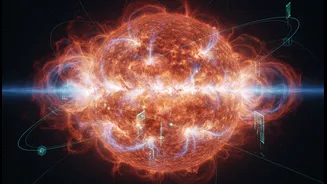
When we think of weather, we imagine rain, wind, and clouds. But there's another kind of weather that originates 150 million kilometres away. Space weather refers to the changing conditions in space driven by the sun. Our star is constantly sending out
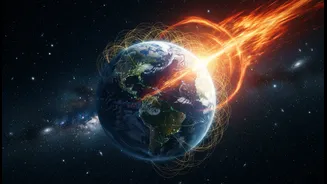
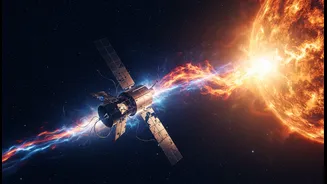
a stream of charged particles called the solar wind. Most of the time, Earth's magnetic field acts as a shield, protecting us from this cosmic barrage. However, the sun is not always calm. It can unleash massive explosions of energy, known as solar flares, and huge clouds of solar material called coronal mass ejections (CMEs). When these intense bursts are aimed at Earth, they can overwhelm our planetary shield, triggering geomagnetic storms that have tangible effects on our modern infrastructure.
Our Fragile Digital Lifeline
In today's world, we are deeply reliant on a vast network of satellites orbiting our planet. They are crucial for everything from GPS navigation and television broadcasts to financial transactions and weather forecasting. These satellites, operating outside the protection of Earth's atmosphere, are highly vulnerable to space weather. Energetic particles from a solar storm can damage sensitive electronics, cause phantom commands, or degrade solar panels over time. Severe storms can also heat and expand Earth's upper atmosphere, increasing drag on satellites in low-Earth orbit. This can alter their trajectory, potentially causing them to collide with other objects or even re-enter the atmosphere prematurely. The impact isn't limited to space; powerful geomagnetic storms can induce currents in ground-based systems, threatening to overload and damage high-voltage transformers in our power grids.
Predicting the Sun’s Mood
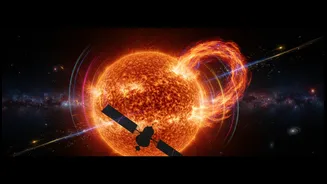
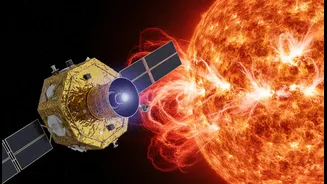
Just as meteorologists forecast terrestrial weather, a growing field of science is dedicated to predicting space weather. This involves continuously monitoring the sun for signs of activity, like the formation of complex sunspot regions, which are often precursors to solar flares. To do this, scientists rely on a network of ground-based and space-borne observatories. A key player in this effort is India's own Aditya-L1 mission. Launched by ISRO, Aditya-L1 is positioned at a special point in space about 1.5 million kilometres from Earth, giving it an uninterrupted view of the sun. Its suite of instruments studies the sun's atmosphere and tracks solar eruptions, providing crucial data that helps improve forecasting models and gives advance warning of potentially disruptive events. By understanding how events like CMEs travel through space, missions like Aditya-L1 help us assess their potential impact on Earth.
A New Frontier for Careers
Our increasing vulnerability to solar outbursts has created a demand for a new type of expert: the space weather forecaster. This burgeoning field combines elements of astrophysics, plasma physics, and data science. Professionals are needed in government agencies, research institutions, and private industries to monitor solar activity and issue timely alerts. These roles include space physicists who study the sun's fundamental processes, data analysts who build and run predictive models, and communications specialists who translate complex data into actionable warnings for industries like aviation, satellite operations, and energy. As humanity's footprint in space expands and our reliance on technology deepens, the need for skilled individuals to interpret the sun's behaviour and safeguard our critical infrastructure will only continue to grow.