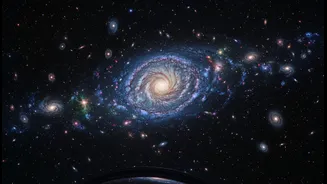









A Glimpse into the Cosmic Dawn
When we look deep into space, we are also looking back in time. The light from the most distant objects has travelled for billions of years to reach us, offering a snapshot of the universe in its infancy. For a long time, scientists believed that the period
shortly after the Big Bang, around 1 to 3 billion years in, was a turbulent era. It was thought that galaxies were small, clumpy, and chaotic, slowly coming together through messy collisions and mergers over billions of years to form the grand, structured spirals and ellipticals we see today. The conventional wisdom was that complex features, the kind that signal a 'mature' galaxy, would take a very long time to develop.
The Unexpected Discovery of Order
A new study, powered by the incredible capabilities of the James Webb Space Telescope (JWST), has found something that challenges this long-held belief. Astronomers from Durham University have discovered a galaxy as it was more than nine billion years ago, or when the universe was just about 4.5 billion years old. This galaxy shows clear signs of advanced organisation. Specifically, it contains a 'nuclear disc'—a dense, rotating disc of stars and gas at its very heart. This feature is common in modern galaxies like our own Milky Way, but finding one so early in cosmic history is a groundbreaking first. It suggests the process of galaxy formation is not just a chaotic free-for-all, but can be a structured and efficient process right from the early days.
Cosmic Conveyor Belts at Work
So, how did this young galaxy get so organised, so fast? The study points to another key structure: a stellar bar. This is a long, bar-shaped collection of stars that stretches across the galaxy's centre. These bars act like cosmic conveyor belts, funnelling gas and dust from the outer regions of the galaxy towards the core. This steady supply of fuel then feeds the formation of the nuclear disc, creating a hotbed of new star creation. The discovery of a stellar bar actively building a nuclear disc in such a young galaxy proves that these internal evolutionary mechanisms were in place much earlier than models had predicted. It shows galaxies can be shaped from the inside out, not just by external forces like mergers.
Rewriting the Textbooks on Galaxy Growth
This finding has profound implications for our understanding of how the universe evolved. If galaxies can mature and build complex structures this quickly, our timelines for cosmic evolution may need a major revision. The presence of a nuclear disc also has a knock-on effect. These dense central regions are believed to be the reservoirs of gas that feed the supermassive black holes lurking at the centres of most large galaxies. By understanding when and how these discs form, scientists can get a clearer picture of how these gargantuan black holes grew to such enormous sizes so early in the universe's history. Essentially, it suggests the universe had the necessary ingredients and processes for building complex, modern-looking galaxies far sooner than we thought.