




The Ultimate Lifeboat: The Crew Escape System
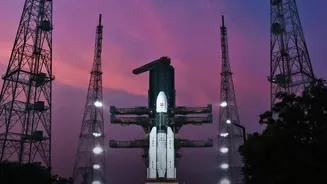
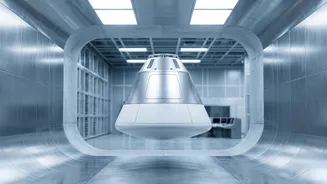
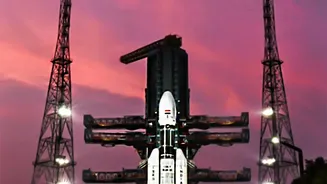
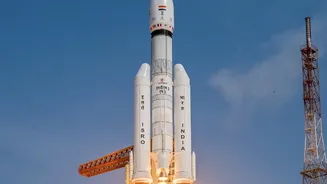
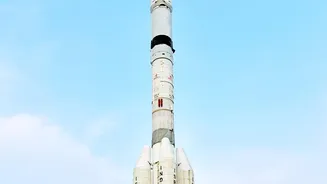
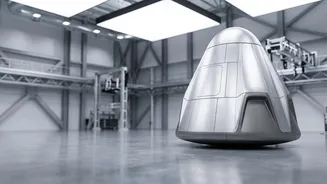
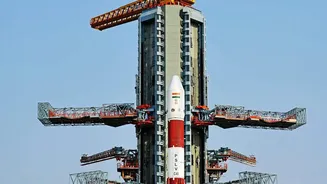
At the heart of Gaganyaan's safety protocol is the Crew Escape System (CES). Think of it as a hyper-advanced lifeboat, not for the sea, but for the sky. Mounted at the very top of the powerful LVM3 rocket, its singular job is to pull the Crew Module—the
capsule carrying the astronauts—away from a failing rocket with ferocious speed. This system is absolutely essential during the launch and ascent phases, which are statistically the most dangerous parts of any space mission. If anything goes wrong, from a loss of thrust to a structural failure, the CES is the astronauts' only way out, providing a safe exit before a potential disaster unfolds.
The Brains of the Operation: Automated Fault Detection
The decision to abort a launch cannot be left to human reaction time; by the time an astronaut or ground control perceived a problem, it would be too late. Instead, Gaganyaan relies on a sophisticated computer network called the Integrated Vehicle Health Management (IVHM) system. This automated 'nervous system' uses a vast network of sensors to monitor thousands of critical parameters in real-time, from engine performance to the structural integrity of the rocket. The IVHM is programmed to detect any deviation from expected performance. If it identifies an anomaly that could threaten the mission, it makes an autonomous, split-second decision to activate the abort sequence, all within milliseconds.
A Symphony of Fire and Speed
Once the IVHM triggers an abort, a precisely timed sequence of events happens in the blink of an eye. First, pyrotechnic devices instantly sever the connections holding the Crew Module to the rocket. Simultaneously, a cluster of powerful, quick-acting solid rocket motors in the CES ignites. These are not ordinary motors; they use special high-burn-rate propellants to generate immense thrust almost instantly, accelerating the capsule away from the booster with a force much greater than the rocket itself. This powerful pull yanks the crew to a safe altitude and distance. Depending on the altitude of the abort, different sets of motors like the Low Altitude Escape Motor (LEM) or High Altitude Escape Motor (HEM) are fired to ensure a safe trajectory away from the failing launch vehicle.
From Fiery Escape to a Gentle Splashdown
Getting away from the rocket is only half the battle. After the escape motors burn out and the CES has done its job, it jettisons from the Crew Module. The module then begins its descent. A meticulously designed parachute system, consisting of multiple stages, deploys to dramatically slow the capsule's fall. This multi-stage process, starting with drogue chutes and followed by main parachutes, ensures the deceleration G-forces remain within safe limits for the astronauts inside. The sequence ends with a gentle splashdown in the ocean, where the Indian Navy has recovery teams on standby to retrieve the crew and capsule.
Proven Through Rigorous Testing
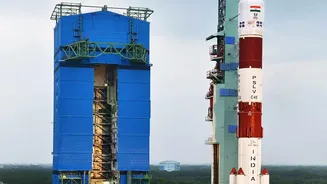
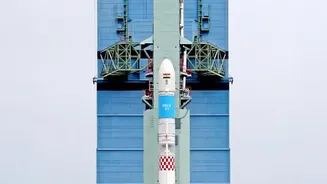
This entire system isn't just theoretical; ISRO has been rigorously testing it to prove its reliability. A key milestone was the Test Vehicle Abort Mission-1 (TV-D1) in October 2023. For this test, ISRO used a specially designed test rocket to carry a boilerplate Crew Module to an altitude of about 17 km. At a speed of Mach 1.2—one of the most aerodynamically stressful points of a launch—they deliberately triggered an in-flight abort. The CES performed flawlessly, pulling the module to safety before it executed a perfect parachute deployment and splashdown. This successful test, among others, demonstrated that the automated systems work exactly as designed, providing critical confidence in the safety measures protecting India's future Vyomanauts.