





The Moon’s Unseen Havens
The lunar surface is a hostile place. Without a protective magnetic field or atmosphere, it is exposed to relentless bombardment from galactic cosmic rays and intense solar radiation. Daily radiation levels are estimated to be about 200 times higher than
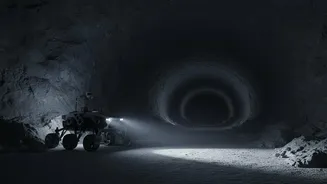
on Earth's surface. But beneath this dangerous landscape lie potential sanctuaries: lava tubes. These vast, hollow caverns were formed billions of years ago when the top layer of a lava flow cooled and hardened while molten rock continued to flow underneath, eventually draining away. Some of these tubes are thought to be massive, potentially hundreds of meters wide and many kilometers long, shielded by thick ceilings of solid rock. This natural overhead protection could drastically reduce radiation exposure, making them prime candidates for future human habitats.
More Than Just Radiation
Cosmic rays aren't the only threat. Astronauts and their equipment must also contend with micrometeorites traveling at extreme speeds and wild temperature swings. During the lunar day, which lasts about two Earth weeks, surface temperatures can soar to 120°C, only to plummet to -130°C during the equally long night. Lava tubes offer a remarkably stable alternative. Sheltered deep underground, they maintain a near-constant, albeit cold, temperature, estimated to be around -20°C. This thermal stability, combined with the protection from radiation and micrometeorites, makes these subterranean worlds incredibly attractive for establishing a long-term, sustainable human foothold on the Moon.
Enter the Robotic Spelunkers
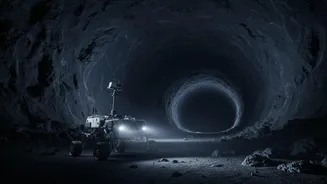
Before humans can move in, we need to know what’s inside these dark, unknown tunnels. Sending human explorers first would be incredibly risky. Instead, space agencies and private companies are developing specialized rovers designed to be the first pioneers of the lunar underworld. These aren't your typical surface rovers. Concepts range from wheeled and legged robots to spherical drones. The European Space Agency (ESA) has been studying a concept called DAEDALUS, a 46-cm spherical robot designed to be lowered into a pit on a tether before rolling off to map the cave autonomously. It would be equipped with a 3D mapping lidar system, cameras, and a radiation dosimeter to scout the environment.
A Mission of Teamwork and Autonomy
Exploring these environments is so complex that some concepts rely on teams of robots working together. One European research team has tested a multi-robot system on Earth in a lava-tube-like environment. Their mission involves a larger rover, SherpaTT, that acts as an anchor at the surface, lowering a smaller, more agile rover named Coyote III into the cave. Once inside, the smaller rover would autonomously explore and create a 3D map of the cavern. This high degree of autonomy is critical, as direct, real-time communication with rovers deep underground will be difficult or impossible. The robots must be smart enough to navigate treacherous, unknown terrain, avoid obstacles, and transmit data on their own, often using a tether or a surface rover as a Wi-Fi relay point.
The Challenges of Cave Exploration
The path to mapping these lunar caves is fraught with challenges. The first step is simply finding a safe way in. Most proposed missions target "skylights," areas where the roof of a lava tube has collapsed, creating a natural entrance. Getting a rover down through one of these pits is a major engineering hurdle. Once inside, the rover faces total darkness, exceptionally rugged terrain, and the risk of losing communication. Companies like Astrobotic are developing small, scalable rovers, such as the CubeRover, designed to be robust and adaptable for a variety of missions, including potential cave exploration. Overcoming these challenges will require significant advancements in robotics, autonomous navigation, and power systems capable of operating in complete darkness for extended periods.