






A Universe of Dangerous Rays
When we look for habitable worlds, we're looking for more than just a rocky planet at the right temperature. Life, as we know it, is fragile. Two of the greatest threats it faces in the cosmos are stellar radiation and galactic cosmic rays. Stellar radiation is the constant
stream of charged particles and energy, like the solar wind, that flows from a star. It also includes violent, unpredictable outbursts like stellar flares. Galactic cosmic rays (GCRs) are even more formidable; they are high-energy particles, remnants of cosmic events like supernovae, that travel through space at nearly the speed of light. Both types of radiation can be lethal, capable of stripping away a planet's atmosphere and bathing its surface in doses that would damage or destroy biological molecules like DNA.
The Planetary Force Field
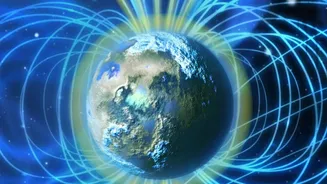
So, how does a planet like Earth survive this cosmic onslaught? The first and most critical line of defense is a magnetosphere. Generated by the motion of molten metal in a planet’s core, this vast magnetic bubble surrounds the planet and deflects the vast majority of incoming charged particles from its star and deep space. Without a magnetosphere, the constant pressure of stellar winds could erode a planet’s atmosphere over time, a fate that scientists believe befell Mars billions of years ago, turning it from a potentially watery world into the barren planet we see today. Therefore, a strong, internally generated magnetic field is now considered a key requirement for a planet to be truly habitable.
A Protective Atmospheric Blanket
A magnetic field isn't a perfect shield. Some high-energy particles will inevitably breach this defense. That’s where a planet's second protective layer comes in: its atmosphere. A sufficiently thick atmosphere acts as a physical shield, absorbing and slowing down radiation before it can reach the surface. When cosmic rays collide with atmospheric gases, they create a shower of secondary, less energetic particles. On Earth, our atmosphere is dense enough to protect us from the worst of this, but on a planet with a thin atmosphere, this secondary radiation could still be harmful. The combination of a strong magnetosphere and a substantial atmosphere is the one-two punch a planet needs to provide a safe harbour for life on its surface.
The Problem with Red Dwarfs
The most common stars in our galaxy are M-dwarfs, or red dwarfs. They have incredibly long lifespans, giving life a long time to potentially evolve. However, they present a unique radiation problem. Their habitable zones are much closer to the star than for a sun-like star. Planets in this zone are often tidally locked, with one side always facing the star. This close proximity exposes them to intense stellar activity, as red dwarfs are known for frequent and powerful flares, especially in their youth. Furthermore, a tidally locked planet may rotate too slowly to generate a strong protective magnetic field, leaving it vulnerable. This means that even planets in the right temperature zone around these common stars might be sterile due to intense radiation.
A Nuanced Definition of 'Habitable'
The constant threat of radiation fundamentally changes our search for life. It's no longer enough to find a planet in the 'habitable zone' where liquid water could exist. Astronomers must now also assess the star's activity and whether the planet has the necessary defenses. A planet's mass, rotation rate, and composition all play a role in its ability to generate a magnetic field and hold onto a thick atmosphere. Interestingly, some recent studies have proposed that in very specific, cold environments, such as under the ice of a moon, cosmic rays could potentially provide the chemical energy needed for life to exist in the absence of sunlight. But for surface life, protection remains key.