
From Fiery Streak to Lab Sample
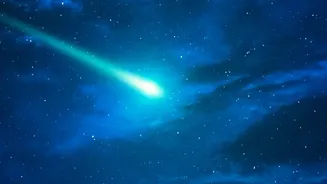
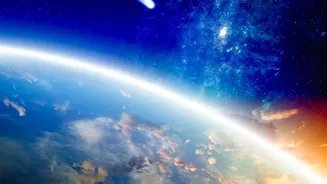
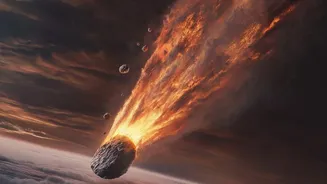
First, it's important to know the terms. A meteoroid is a piece of rock or debris in space, often broken off from an asteroid or a comet. When it enters Earth’s atmosphere and burns up, the streak of light it creates is called a meteor. If any part of it survives
the fiery descent and hits the ground, it becomes a meteorite. Most meteors are simply observed, but the ones that become meteorites are invaluable. They are physical relics from the cloud of gas and dust that formed our sun and planets. Scientists have spent entire careers studying these cosmic visitors because they provide a direct record of our solar system's birth and evolution, a history that is otherwise inaccessible.
Analysing Light from a Distance
Even without a physical rock to hold, astronomers can learn a surprising amount just from the light a meteor produces as it burns. This is done through a technique called spectroscopy. By passing the meteor’s light through a device called a diffraction grating, scientists can split it into a rainbow of colours, known as a spectrum. Each chemical element burns with a unique colour signature, creating distinct bright lines in the spectrum. These lines act like a chemical fingerprint. By analyzing which lines are present and how bright they are, researchers can determine the meteoroid's composition, identifying elements like iron, magnesium, calcium, and sodium from millions of miles away.
The Hunt for Fallen Stars
When a particularly large meteor, known as a fireball or bolide, is detected, the race is on to find potential fragments. Networks of cameras are set up to triangulate the path of bright meteors, helping to narrow down the potential landing zone. The 2013 Chelyabinsk event in Russia, which produced a shockwave that injured over 1,500 people, was a dramatic reminder of the power of these impacts and yielded thousands of meteorite fragments for study. Similarly, the Allende meteorite, which fell in Mexico in 1969, scattered over two tons of material, making it one of the most studied meteorites in history. Recovering these rocks quickly is crucial to preserve their pristine state before they are contaminated by Earth's environment.
Inside the Cosmic Time Capsules
Once in the lab, a meteorite becomes a treasure trove of information. Scientists use a variety of techniques to unlock its secrets. Mass spectrometry helps determine the precise age of the rock by measuring the decay of radioactive isotopes, a process that has allowed researchers to date our solar system to about 4.56 billion years old. Microscopic analysis reveals the rock’s structure, including tiny, spherical grains called chondrules. These are some of the first solid materials to have condensed from the early solar nebula. Certain primitive meteorites, known as carbonaceous chondrites, are especially valuable. They are rich in carbon, water, and even organic compounds, offering a snapshot of the raw materials that were present when the planets were forming.
Building Blocks of Planets and Life
The study of meteorites has reshaped our understanding of planetary formation. The composition of different meteorite groups suggests they originated from distinct regions of the early solar system—an inner, drier region and an outer, icier one, possibly separated by the immense gravity of a young Jupiter. The discovery of this divide helps explain why we have rocky inner planets and gas giants in the outer solar system. Furthermore, some meteorites contain the building blocks of life, such as amino acids and complex organic molecules. This suggests that ancient impacts could have delivered these essential ingredients, and water, to a young, barren Earth, potentially kickstarting the processes that led to life.