


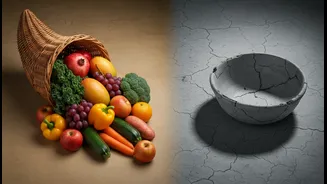




More Food, Not Enough Nutrition
For decades, India's approach to food security was measured by a simple metric: calorie sufficiency. The focus was on producing enough staples like rice and wheat to feed its vast population. Policies like the Public Distribution System (PDS) were designed
to ensure that no one went hungry by providing subsidised grains. While these efforts have been successful in staving off widespread famine, they have inadvertently created a new set of challenges. Indian diets have become heavily reliant on cereals, which are calorie-dense but lack essential micronutrients. At the same time, household expenditure on food as a percentage of total spending has declined for the first time, reflecting both improved economic conditions and the effectiveness of food security programs. However, this dietary shift has not uniformly moved towards healthier options.
The Changing Indian Thali
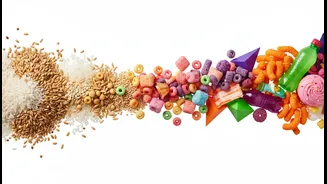
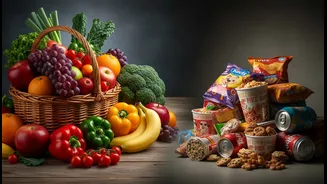
So, what does the modern Indian food basket look like? There is a clear trend of diversification, with increased consumption of milk, fruits, eggs, and meat, especially among lower-income households who are spending less on basic cereals. However, this is only part of the story. There has also been a significant rise in the consumption of processed and ultra-processed foods. The share of spending on beverages and processed foods more than doubled between the early 2000s and 2022-23. This shift is creating a dual problem: while some diversify towards nutritious foods, many are replacing traditional, whole foods with convenient but unhealthy alternatives that are high in carbohydrates and fats but poor in essential proteins and vitamins. Even for the richest segments of the population, consumption of nutrient-dense foods like fruits and vegetables remains limited.
The High Price of Eating Healthy
A major barrier to better nutrition is simple economics. For a large portion of the population, a healthy and diverse diet is simply unaffordable. A 2026 study estimated that the daily cost of a healthy vegetarian diet is around ₹64, while a non-vegetarian one is about ₹73. For millions, this is an insurmountable sum. The study found that over 56% of the rural population and 31% of the urban population would need to spend more than they currently do on food to afford a healthy diet. Even when staple grains are subsidised, the cost of other essential items like vegetables, fruits, pulses, and dairy products remains high. This economic pressure forces many families to opt for cheaper, energy-dense foods, perpetuating a cycle of poor nutrition.
An Invisible Crisis: Hidden Hunger
This leads to a phenomenon known as 'hidden hunger', or micronutrient deficiency. It’s a condition where a person consumes enough calories but lacks essential vitamins and minerals like iron, vitamin A, zinc, and folate. India bears a staggering burden of this silent epidemic, with some estimates suggesting nearly half the world's micronutrient-deficient population lives here. The consequences are severe. Iron deficiency anaemia is rampant, affecting over half of all women and a majority of young children. These deficiencies impair cognitive development in children, reduce productivity in adults, and increase vulnerability to illness across all age groups. It is a crisis that doesn't show up as starvation but quietly undermines the health and potential of a generation.
The Double Burden of Malnutrition
The outcome of these dietary shifts is a complex public health challenge known as the 'double burden of malnutrition'. This is where undernutrition and hidden hunger coexist with a growing epidemic of overweight and obesity. The same carbohydrate-heavy, nutrient-poor diets that cause stunting and anaemia in children are also contributing to a rise in non-communicable diseases like diabetes and heart disease in adults. India is now one of the fastest-growing markets for ultra-processed foods, and a rise in obesity has been recorded in tandem with this trend. This means the country's healthcare system has to fight a war on two fronts: one against the deficiencies of the past and another against the excesses of the present.