






Why Saturn is Shining Brightly Now
The reason for Saturn's prominence this October is a celestial event called opposition, which occurred on October 4, 2026. Opposition happens when Earth passes directly between the Sun and an outer planet, in this case, Saturn. From our viewpoint, Saturn is on the opposite
side of the sky from the Sun. This means the planet rises in the east around sunset, soars to its highest point around midnight, and sets in the west near sunrise, making it visible all night long. This alignment also brings Saturn to its nearest point to Earth for the year, at a distance of about 1.26 billion kilometres. This proximity makes it appear larger and brighter than at any other time, shining with a steady, pale golden light.
The Spectacular Seeliger Effect
Adding to the spectacle is a phenomenon that makes Saturn’s rings appear unusually brilliant around opposition: the Seeliger effect. Saturn's rings are made of countless particles of ice and rock. Normally, these particles cast tiny shadows on each other, slightly dimming their collective glow. During opposition, however, the Sun is almost directly behind us as we look at Saturn. This unique angle means we see the ring particles fully illuminated, with their shadows hidden from our view. This causes a noticeable surge in the rings' brightness, a subtle but beautiful effect best appreciated through a telescope in the days surrounding opposition.
A Simple Guide to Finding Saturn
You don't need to be an expert astronomer to spot Saturn. Its brightness, at a magnitude of +0.3, makes it easily visible to the naked eye, even from areas with some light pollution. For observers in India, Saturn rises in the eastern sky around 6:11 pm and remains a captivating presence throughout the night. To find it, look for a bright, steady, yellowish point of light that doesn't twinkle like a star. This month, it can be found in the constellation Cetus, the Whale, below the large asterism known as the Great Square of Pegasus in the eastern sky after dark. Using a stargazing app on your phone can also help you pinpoint its exact location with ease.
Using Binoculars and Telescopes
While Saturn is impressive to the naked eye, using optical aids will transform your viewing experience. A good pair of binoculars will reveal that Saturn is not a simple point but slightly oval-shaped, a hint of its famous rings. However, to truly see the rings as separate from the planet, you'll need a telescope. Even a small, beginner telescope with about 50x magnification can provide that breathtaking first glimpse of the rings, a sight that has wowed observers since Galileo. With a more powerful telescope (100-150x), on a clear and steady night, you might even be able to spot the Cassini Division—the dark gap between its main rings—and its largest moon, Titan, appearing as a faint nearby star.
What Makes the Rings So Special?
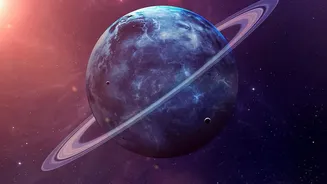
Saturn’s rings are a wonder of the solar system. They are not solid but composed of billions of chunks of ice and rock, ranging from dust-sized specks to pieces as large as a house. This year's viewing is particularly special because the rings are tilting open again from our perspective, after being nearly edge-on and invisible in 2025. The rings stretch across hundreds of thousands of kilometres but are incredibly thin, perhaps only 10 metres to one kilometre thick in most places. Scientists believe they are either the remnants of a shattered moon, comet, or asteroid torn apart by Saturn's immense gravity. Though they look permanent, the rings are a dynamic system, and may only last for a few hundred million years—a brief moment in cosmic time.