




The Anatomy of a Desk-Bound Body
Our bodies are designed for movement, but modern work often forces us into a sedentary state for eight hours or more a day. When you sit for prolonged periods, your body adapts to that position. The primary issue arises from the constant hip flexion—the
angle created when your thighs are bent towards your torso. This static posture creates a cascade of problems, primarily by causing a major imbalance in the muscles surrounding your pelvis. The muscles at the front of your hips, known as the hip flexors, remain in a shortened, contracted state. Meanwhile, the muscles at the back, your glutes, are lengthened and become inactive. Over time, this doesn't just make you feel stiff; it fundamentally changes how your body moves.
Tight Flexors and 'Sleeping' Glutes
Think of your hip muscles as a balanced tug-of-war. Your hip flexors pull your pelvis forward, while your glutes and hamstrings pull it back. Prolonged sitting gives the hip flexors a massive advantage. They become short and tight, constantly pulling your pelvis into a slight forward tilt. This can contribute to lower back pain as your spine is forced to over-arch to compensate. Simultaneously, your gluteal muscles, which are supposed to be among the most powerful in your body, essentially go to sleep. This phenomenon is often called 'gluteal amnesia' or 'dead butt syndrome'. Because they aren't being used to stabilize your pelvis or extend your hips, they become weak and forget how to activate properly, forcing other, smaller muscles to do a job they weren't designed for. This imbalance is a primary driver of hip pain, poor posture, and even an increased risk of injury.
Reclaiming Mobility: Simple Exercises for Fast Relief
The good news is that this desk-induced damage is largely reversible with consistent, targeted movement. You don't need a grueling gym session to counteract the effects of sitting. By focusing on two key goals—stretching the tight hip flexors and reactivating the dormant glutes—you can find significant relief. The following exercises are simple enough to do at home with minimal space and no equipment. Aim to perform them most days of the week for the best results. A few minutes a day can make a world of difference in how you feel.
1. Kneeling Hip Flexor Stretch
This is the classic antidote to shortened hip flexors. Kneel on your left knee (placing a cushion underneath for comfort) and plant your right foot on the floor in front of you, creating a 90-degree angle with your right knee. Keeping your back straight and core engaged, gently push your hips forward until you feel a stretch in the front of your left hip and thigh. Avoid arching your lower back; the movement should be focused at the hip. Hold for 30 seconds, then switch sides. Repeat two to four times per side.
2. Seated Figure-Four Stretch
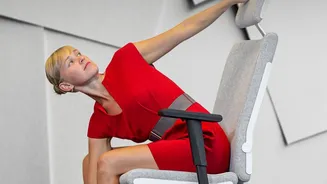
This stretch targets the outer hip and glute muscles, including the piriformis, which can become tight and contribute to hip pain. You can even do a version of this while sitting in your office chair. Sit on the floor or the edge of a chair with your back straight. Cross your right ankle over your left knee. Gently press down on your right knee to deepen the stretch until you feel it in your right glute and outer hip. To increase the intensity, you can hinge forward at your hips. Hold for 30 seconds, then repeat on the other side.
3. Glute Bridge
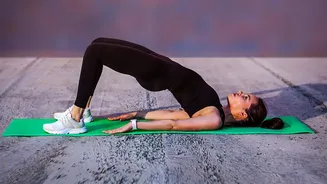
After hours of inactivity, the glute bridge is the perfect exercise to wake up your glutes. Lie on your back with your knees bent, feet flat on the floor about hip-width apart, and your arms by your sides. Squeezing your glutes, lift your hips off the floor until your body forms a straight line from your shoulders to your knees. Be careful not to hyperextend your back. Hold for a few seconds at the top, focusing on the contraction in your glutes, then slowly lower your hips back down. Aim for 10-15 repetitions.
4. Butterfly Stretch
This simple stretch helps to open up the hips and stretch the inner thigh muscles (adductors), which also play a role in overall hip health. Sit on the floor and bring the soles of your feet together, letting your knees fall out to the sides. Hold onto your ankles or feet and sit up tall. To deepen the stretch, you can gently press your knees towards the floor or hinge forward from your hips, keeping your back straight. Hold for 30 seconds.