
A Faint New Point of Light
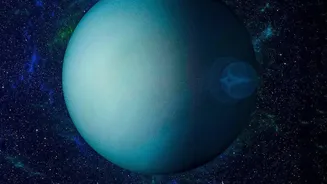
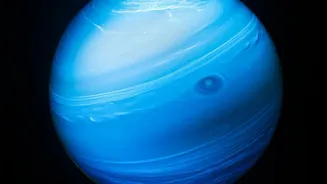
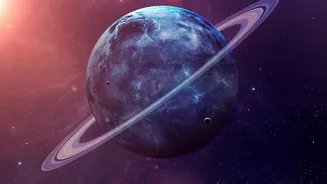
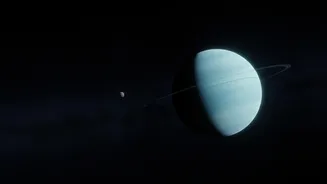
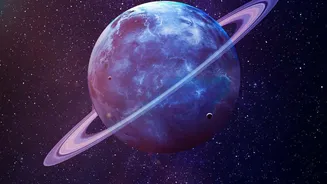
In the vast, cold darkness of the outer solar system, spotting a new object is a monumental task. The latest discovery, provisionally named S/2023 U1, is a case in point. Measuring only about eight kilometres across, it’s likely the smallest of Uranus’s
28 known moons. The find was made by astronomer Scott S. Sheppard using the powerful Magellan telescopes in Chile, and it took special image processing techniques to even reveal the faint object. The discovery was a painstaking process, requiring follow-up observations and analysis of older images to confirm that this faint speck was indeed gravitationally bound to Uranus. This tiny world takes a staggering 680 Earth days to complete a single orbit around its parent planet. Like all of Uranus's other outer satellites, it will eventually be given a permanent name from a Shakespearean play.
What Makes This Orbit So Unusual?
Most of a planet’s major moons, like our own, tend to follow relatively neat, circular paths around their planet's equator. These are known as regular moons, and they are believed to have formed from the same disk of gas and dust as the planet itself. The new moon, however, is what scientists call an “irregular” moon. Its orbit is distant, highly elliptical, and significantly tilted compared to Uranus’s equatorial plane. Instead of a clean, circular track, its path is a long, lopsided loop. This strange dance is a dead giveaway to scientists that the moon wasn't born alongside Uranus. An orbit this peculiar suggests a more violent and dramatic origin story, one that begins far away from the ice giant.
A Captured Relic from the Solar System’s Past
The leading theory is that S/2023 U1 is a captured object. Millions, or even billions, of years ago, it was likely a small body journeying through the chaotic early solar system, perhaps originating from the distant Kuiper Belt, a vast ring of icy objects beyond Neptune. At some point, its path brought it too close to the immense gravity of Uranus, and it was snared, forced into the strange orbit we see today. This process of capture would explain its distant and inclined path. All the giant planets in our solar system, including Jupiter and Saturn, have similar families of irregular, captured moons, each one a relic from a time when the solar system was a much more crowded and wild place. Studying these captured worlds gives us a direct look at the building blocks of the outer solar system.
A Clue to Cosmic Collisions
The story gets even more interesting. Scientists noticed that the new moon’s orbit is strikingly similar to that of two other Uranian irregular moons, Caliban and Stephano. When astronomers see a cluster of small moons sharing similar orbital paths, it often points to a single, dramatic event. The most likely scenario is that a much larger captured moon was once in this orbit, but it was shattered by a cataclysmic collision with a passing comet or asteroid. The fragments from that ancient impact, including S/2023 U1, Caliban, and Stephano, continued along similar orbital trajectories, forming a dynamical family. By studying this group, scientists can piece together the history of this cosmic smash-up, learning more about the frequency and nature of collisions in the outer solar system long after the planets themselves had formed.