
A Cosmic Time Machine
The secret to Webb's time-traveling ability lies in a simple, fundamental concept: the speed of light. Light travels incredibly fast, but not instantaneously. When we look at the Moon, we see it as it was 1.3 seconds ago. For the Sun, it's about eight
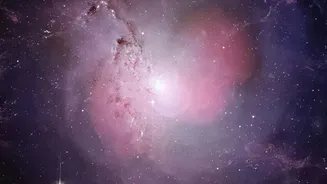
minutes. For distant stars, it could be hundreds or thousands of years. The James Webb Space Telescope (JWST) takes this principle to the extreme. It is designed to look at galaxies so far away that their light has taken billions of years to reach us. This means we are not seeing these galaxies as they are today, but as they were in their infancy, just a few hundred million years after the Big Bang. In essence, looking deep into space is the same as looking far back in time, and Webb is the most powerful tool humanity has ever built to do just that.
The Expanding Universe's Trick
There's a cosmic complication that makes seeing this ancient light tricky. Since the Big Bang, the universe has been constantly expanding. As it expands, it stretches everything within it, including the waves of light travelling through space. This phenomenon is called 'cosmological redshift'. Think of it like a sound wave from an ambulance siren that sounds higher-pitched as it approaches you and lower-pitched as it moves away. As distant galaxies speed away from us due to cosmic expansion, the light they emit is stretched into longer, redder wavelengths. The light from the very first stars and galaxies was originally emitted as visible or even ultraviolet light, but over its 13-billion-year journey, it has been stretched so much that it now arrives at Earth as infrared light, which is invisible to the human eye.
Seeing the Invisible with Infrared
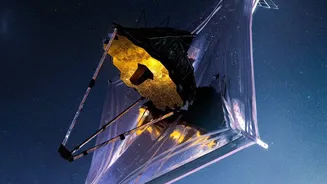
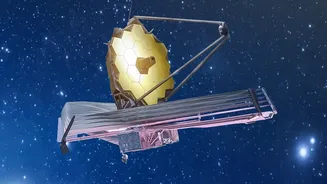
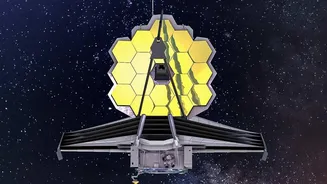
This is where Webb’s specialty comes in. Unlike the Hubble Space Telescope, which primarily observes in visible and ultraviolet light, JWST is optimized to detect infrared light. Its instruments are specifically designed to capture these faint, stretched-out wavelengths from the dawn of time. To do this, the telescope itself must be kept incredibly cold, at a temperature below -223°C. This is because any warm object, including a telescope, emits its own infrared radiation (heat). If Webb were warm, it would blind its own sensitive detectors, swamping the faint signal from distant galaxies. A massive, five-layer sunshield, the size of a tennis court, protects the telescope from the heat of the Sun, Earth, and Moon, allowing it to see the faint infrared glow of the early universe.
Webb's Superpowered Eyes
Capturing this ancient, faint light requires a huge mirror and highly advanced instruments. Webb's primary mirror is over 6.5 meters in diameter, composed of 18 hexagonal, gold-coated segments. This large area allows it to collect far more light than Hubble, enabling it to see objects that are 100 times fainter. This light is then channelled to a suite of four state-of-the-art instruments. The Near-Infrared Camera (NIRCam) is its primary imager, responsible for taking the breathtaking deep-field pictures that reveal thousands of ancient galaxies in a single shot. The Near-Infrared Spectrograph (NIRSpec) and Mid-Infrared Instrument (MIRI) then analyze this light, breaking it down into a spectrum to determine the composition, temperature, and motion of these early cosmic objects. This is how scientists can identify the elements present in the first stars and galaxies.
Piecing Together the Cosmic Dawn
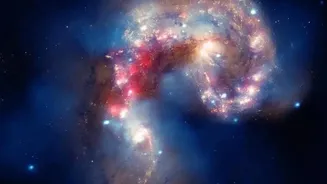
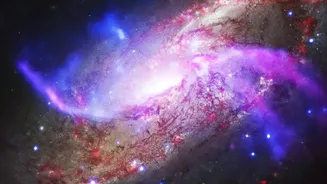
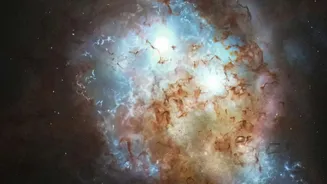
By combining these capabilities, Webb helps astronomers answer fundamental questions about our origins. Its mission is to study the 'Epoch of Reionization', the period when the first stars and galaxies formed and lit up the universe, which was previously a dark place filled with neutral hydrogen gas. The light from these first stellar objects ionized the surrounding gas, transforming the cosmos into the transparent, star-filled universe we see today. Before Webb, this era was largely theoretical. Now, scientists can directly observe the galaxies responsible for this great change. They can study how these early, often strangely-shaped galaxies merged and evolved over billions of years into the grand spiral and elliptical structures we see in the universe today.