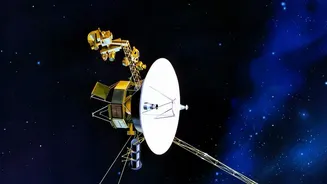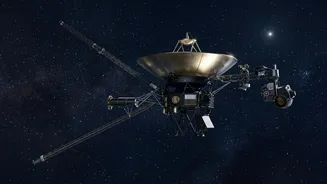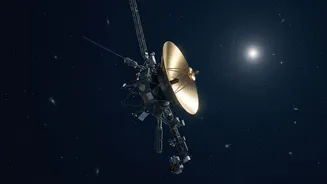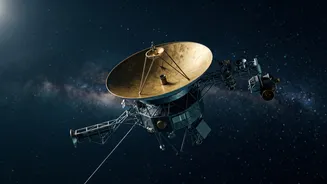




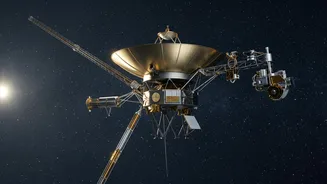
In the vast, silent theatre of space, a tiny emissary from Earth is about to hit a staggering milestone. Launched nearly 50 years ago, NASA's Voyager 1 spacecraft will soon be one light-day away, the farthest any human object has ever traveled.
A Journey Beyond Imagination
On November
18, 2026, Voyager 1 will be 25.9 billion kilometers from home. This isn't just another number on a mission log; it's a distance so immense that it takes light itself a full 24 hours to cross it. When engineers at NASA's Jet Propulsion Laboratory send a command, they must wait 48 hours for a reply, a cosmic conversation with a two-day delay. This milestone is a quiet triumph for a machine built in the 1970s, operating on less power than a modern light bulb, that has become humanity's longest-serving explorer in the interstellar void.
The Grand Tour's Enduring Legacy
Voyager 1, along with its twin, Voyager 2, began its journey on September 5, 1977. Its original mission was a 'Grand Tour' of the outer planets, taking advantage of a rare planetary alignment that happens once every 176 years. It delivered breathtaking discoveries, capturing the first close-up views of Jupiter's Great Red Spot and discovering active volcanoes on its moon Io. At Saturn, it unveiled the intricate structure of the rings and the thick, nitrogen-rich atmosphere of the moon Titan. After completing its primary mission in 1980, it began its long journey toward the stars, officially entering interstellar space in August 2012.
A Faint Voice in the Darkness
Keeping a nearly 50-year-old spacecraft alive is a masterclass in ingenuity. Voyager 1's power comes from decaying plutonium, a supply that dwindles by about 4 watts each year. This has forced engineers to make difficult decisions, shutting down instruments one by one to conserve energy. Today, only two of its original science instruments remain active, listening to the faint vibrations of interstellar plasma. The mission isn't without its scares. In October 2026, the probe fell silent for 48 hours before communication was thankfully restored. More recently, in a delicate maneuver nicknamed the 'Big Bang', engineers successfully swapped to lower-power backup systems to extend the probe's life.
Our Silent Ambassador to the Stars
Beyond its scientific instruments, Voyager 1 carries a message: the Golden Record. This gold plated copper disk contains a time capsule of sounds and images from Earth, a portrait of our world for any civilization that might one day find it. It includes greetings in 55 languages, music from across cultures, and images of human life and our planet's diverse ecosystems. It is a symbol of our hope and curiosity, a greeting card sent to the cosmos with no specific address. While its primary mission was scientific, its cultural legacy as our silent ambassador may be just as profound.
The Long Road Ahead
The one light day mark is likely the last major milestone Voyager $1$ will report home. Its power is expected to fade completely by the mid $2030$s , at which point its faint signal will be lost to the background noise of the universe. But its journey will not end. Coasting at nearly $61 ,000$ kilometers per hour , it will take about $300$ years to reach the inner edge of the Oort Cloud , a vast , icy shell at the fringe of our solar system. In roughly $40 ,000$ years , it will drift past the star Gliese $445$ . Long after it falls silent , our most distant creation will continue its lonely trek , a testament to the moment a curious species looked to the stars and decided to go.