



A System of Superlatives
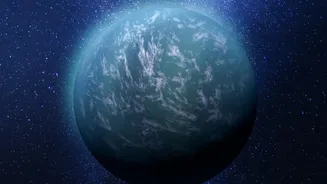
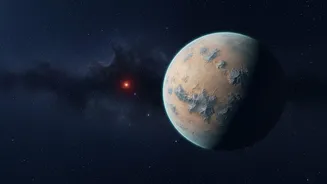
The TRAPPIST-1 system is an icon in the search for life beyond Earth. It features seven rocky, Earth-sized planets orbiting a small, cool red dwarf star. What makes it so special is that at least three of these worlds—planets d, e, and f—orbit within
the star's 'habitable zone'. This is the temperate region where temperatures could theoretically allow liquid water to exist on a planet's surface, a crucial ingredient for life as we know it. Since its discovery, this compact solar system has been a prime target for astronomers, representing a natural laboratory for studying the formation and potential habitability of rocky planets outside our own.
The Venus Twin That Wasn't
Initial hopes were pinned on planets like TRAPPIST-1c. It is similar in size to Venus and receives a comparable amount of radiation from its star, leading scientists to believe it could be a 'Venus twin'. This theory suggested the planet might have a thick, high-pressure atmosphere dominated by carbon dioxide—what one might call a 'heavy carbon envelope'. Such an atmosphere would create a runaway greenhouse effect, making the planet incredibly hot, just like Venus. Confirming this would have been a landmark discovery, proving that other solar systems could produce planets so similar to our own neighbours.
Webb's Surprising Revelation
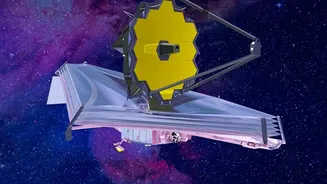
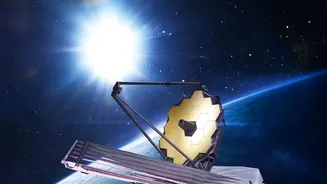
However, when the James Webb Space Telescope (JWST) pointed its powerful infrared eye at TRAPPIST-1c, it delivered a major surprise. The data showed that the planet's dayside temperature is around 110 degrees Celsius. While hot, this is significantly cooler than Venus, whose thick carbon dioxide blanket pushes surface temperatures to over 450 degrees Celsius. The JWST observations effectively ruled out a thick, Venus-like CO2 atmosphere. Instead, the findings suggest that TRAPPIST-1c either has a very thin atmosphere with minimal carbon dioxide or is simply a bare, airless rock. This was not a confirmation, but a fascinating refutation of a leading theory.
Looking for Air in the Habitable Zone
Scientists then turned their attention to the planets in the habitable zone, like TRAPPIST-1d and 1e. For TRAPPIST-1d, observations have so far failed to detect any clear signs of an atmosphere at all. For TRAPPIST-1e, arguably one of the most promising candidates for habitability, JWST has again ruled out a thick, carbon-dioxide-rich atmosphere. While the door isn't completely closed—a thinner atmosphere made of heavier molecules like nitrogen is still possible—the simplest scenarios for Earth-like or Venus-like atmospheres have been discounted. The evidence across the system is pointing away from worlds shrouded in heavy carbon gas.
A New Chapter in an Alien Mystery
The consistent lack of thick atmospheres, especially on the inner planets, suggests the entire TRAPPIST-1 system may have formed with a more limited reservoir of volatile materials like water and carbon dioxide than previously hoped. This doesn't mean the planets are uninteresting; it just means they are different from what we imagined. These findings are a powerful demonstration of the JWST's capabilities. Science is not just about confirming what we expect, but also about revealing the unexpected. By showing what isn't there, the telescope is helping scientists refine their models of how planetary systems form and evolve around the most common type of star in the galaxy.