




An 'Impossible' Glimpse into the Dawn
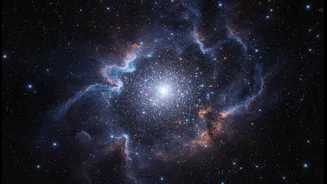
In a remarkable discovery, astronomers using the Hubble telescope have detected ultraviolet light from a galaxy named MXDFz4.4, which existed just 1.4 billion years after the Big Bang. This was thought to be impossible. For the first billion years of
cosmic history, the universe was filled with a thick, opaque fog of neutral hydrogen gas that should have blocked this type of light. Spotting this light is like seeing a flashlight beam through a dense wall of fog miles thick. The galaxy itself is a compact powerhouse; it's about 100 times smaller than our Milky Way but is creating stars at a rate 10 times faster. This intense, concentrated star birth is what scientists believe allowed the galaxy to punch holes in the surrounding cosmic fog, making it visible.
The Standard Story of Galaxy Birth
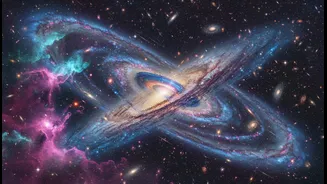
For decades, the prevailing theory of galaxy formation has been a 'bottom-up' or hierarchical model. This idea suggests that after the Big Bang, gravity slowly pulled together small clumps of matter and gas. These initial protogalaxies were thought to be small, messy, and irregular. Over billions of years, these smaller structures would collide and merge, gradually building the large, well-ordered spiral and elliptical galaxies we see in the universe today, including our own Milky Way. According to this model, a galaxy as young as MXDFz4.4 should be a chaotic toddler, not a well-defined entity capable of clearing its own cosmic neighbourhood.
A Challenge to the Cosmic Timeline
The existence of MXDFz4.4 presents a significant puzzle that challenges the established timeline. The key issue isn't just its existence, but its behaviour. The galaxy's ability to clear the surrounding hydrogen fog with its own starlight suggests a level of maturity and concentrated power that the bottom-up model doesn't easily account for at such an early stage. This galaxy is behaving in a way that scientists expected from much larger, more developed galaxies billions of years later. This discovery implies that at least some primitive galaxies could grow and influence their environment far more rapidly and efficiently than previously believed. The old theory isn't necessarily wrong, but it appears to be incomplete.
Rethinking the Rules of Reionization
This discovery provides crucial new evidence about a key period in cosmic history known as the 'Epoch of Reionization'. This was the transformative era when the universe transitioned from being opaque to transparent, as the light from the first stars and galaxies ionized the neutral hydrogen fog. How this happened has been a major unanswered question. MXDFz4.4 provides a direct example of how it worked. It suggests that numerous small, intensely star-forming galaxies could have been the primary engines driving this cosmic clearing. Rather than a slow, gradual process, reionization might have been driven by these powerful, compact galaxies acting like cosmic blowtorches, creating bubbles of transparency that eventually merged to clear the entire universe.
The Road Ahead for Webb and Beyond
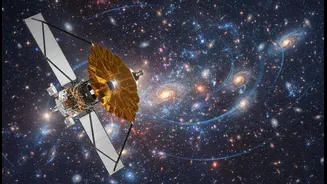
While Hubble made this groundbreaking detection, it's a collaborative effort with other observatories, including the James Webb Space Telescope (JWST), that is painting the full picture. This finding serves as a critical signpost for future research. Astronomers will now hunt for more galaxies like MXDFz4.4 to see if it's a unique exception or a common example of an overlooked pathway for galaxy evolution. The JWST, with its powerful infrared vision, is perfectly suited to peer even deeper into this foggy era. These new observations are forcing theorists to refine their computer simulations and models, potentially adding new factors like 'bursty' star formation or different efficiencies in converting gas to stars in the early universe.