


A Perfect Cosmic Coincidence
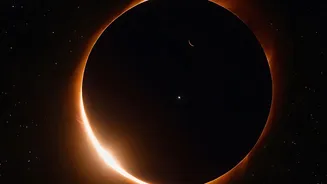
A total solar eclipse occurs when the Moon passes directly between the Sun and Earth, completely blocking the Sun's face. This alignment casts a shadow onto Earth, and for those within the darkest part of that shadow, day briefly turns to twilight. This phenomenon
is possible due to a remarkable coincidence: the Sun is about 400 times larger than the Moon, but it's also about 400 times farther away. This makes them appear almost the exact same size in our sky, allowing the Moon to perfectly obscure the Sun's bright disk.
The Umbra and Penumbra Explained
The Moon's shadow has two parts: the umbra and the penumbra. The umbra is the dark, inner cone of the shadow where the Sun is completely blocked. To witness a total solar eclipse, you must be located within the path of totality, which is the narrow track of the umbra moving across the Earth's surface. For the August 12 eclipse, this path stretched from Greenland and western Iceland to northern Spain. Observers in the larger, fainter outer shadow, the penumbra, only see a partial eclipse, where the Moon covers just a portion of the Sun.
Revealing the Sun's Fiery Crown
Perhaps the most scientifically valuable aspect of a total solar eclipse is the rare glimpse it provides of the Sun's corona. The corona is the Sun's outer atmosphere, a wispy region of superheated plasma that extends millions of kilometres into space. Normally, it's invisible, completely washed out by the intense brightness of the Sun's surface, or photosphere. During totality, when the photosphere is blocked, the ethereal, pearly white corona becomes visible to the naked eye. Scientists seize these few precious minutes to study its structure and behaviour, helping to unravel mysteries like why the corona is millions of degrees hotter than the surface below.
Baily's Beads and the Diamond Ring
Just before and after totality, observers can witness two stunning light effects. The first is known as Baily's Beads. Because the Moon's edge is not smooth but rugged with mountains and valleys, sunlight can peek through the lunar valleys in the final seconds before totality. This creates a string of brilliant points of light that look like beads. As these beads disappear one by one, a final, single point of sunlight shines brightly, creating the famous "diamond ring" effect, with the faint ring of the inner corona forming the band. This breathtaking sight signals that totality is just seconds away, and it reappears in reverse order as the eclipse concludes.
A Laboratory in the Sky
Total solar eclipses are more than just beautiful events; they are natural laboratories. Historically, the 1919 eclipse provided crucial evidence for Einstein's theory of general relativity by showing that the Sun's gravity could bend starlight. Today, they allow for unique studies of the Sun's magnetic field, the solar wind, and the Sun's influence on Earth's atmosphere. The August 12 event, with its path over accessible locations in Iceland and Spain, provided astronomers with another valuable opportunity to gather data, continuing a long tradition of eclipse science that pushes the boundaries of our cosmic understanding.