




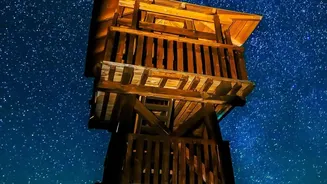

What Exactly is a Dark Sky Reserve?
Think of it as a national park for the night sky. A Dark Sky Reserve is an area recognised for its exceptional starry nights, with measures in place to protect this natural darkness from light pollution. These reserves typically have a dark 'core' area with pristine
skies, surrounded by a periphery where communities have adopted smart lighting policies to prevent light from spilling upwards. The goal is to safeguard these views for scientific research, public enjoyment, and to protect nocturnal ecosystems. Hanle's designation, established in December 2022, marks it as the very first of its kind in India and South Asia.
Why Hanle, Ladakh?
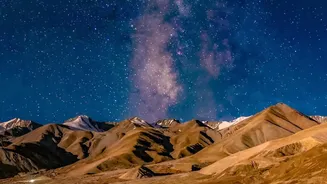
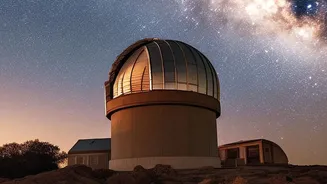
Hanle's selection was no accident; it is a location uniquely suited for stargazing. Situated at an altitude of 4,500 metres in the Changthang region, the site boasts some of the most ideal astronomical conditions on the planet. Its high, dry, and cold desert environment means there is very little atmospheric water vapour or haze to obscure the view. The region enjoys over 255 clear nights a year, a boon for astronomers. This is why the Indian Institute of Astrophysics (IIA) established the Indian Astronomical Observatory (IAO) here back in 2001, which is home to some of the world's highest telescopes. The reserve, covering a 22-kilometre radius around the observatory, was created to protect this world-class scientific site.
A Network of Science and Community
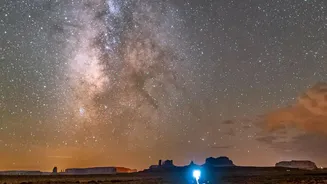
The Hanle Dark Sky Reserve is more than just a protected piece of land; it's a collaborative network. The project is managed through a memorandum of understanding between the UT Ladakh administration, the Ladakh Autonomous Hill Development Council (LAHDC), and the Indian Institute of Astrophysics (IIA). This partnership ensures that preserving the dark sky is a shared responsibility. To minimise light pollution, local villages within the reserve are adopting responsible lighting practices. This includes using shielded lamps, warm-coloured bulbs, and even thick curtains to prevent light from escaping homes and buildings. The rules even extend to vehicle headlights, which must be managed to protect the darkness that is so vital for the sensitive telescopes at the IAO.
A Boost for Astro-Tourism and Livelihoods
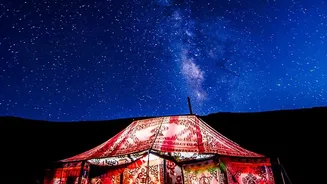
While safeguarding science is a primary goal, the reserve is also designed to empower the local community through astro-tourism. The pristine sky, rated Bortle 1—the darkest classification possible—offers visitors a view of the Milky Way in stunning detail, something unimaginable from a city. To facilitate this, the IIA has trained dozens of local residents, many of them women, to become 'Astronomy Ambassadors'. These guides are equipped with telescopes and the knowledge to lead stargazing sessions for tourists, creating a new, sustainable source of income. Homestays are flourishing, and the motto "come for the mountains, stay for the stars" is becoming a reality, linking conservation directly to economic benefit for the people of Hanle.
Looking to the Future
The establishment of the Hanle Dark Sky Reserve is a forward-thinking initiative that blends scientific progress with sustainable development and cultural preservation. For astronomers, it ensures that the Indian Astronomical Observatory can continue its cutting-edge research without the threat of encroaching light pollution. For travellers and stargazers, it offers a rare and profound opportunity to connect with the universe in a way that is becoming increasingly scarce. And for the people of Hanle, it provides a unique economic opportunity that is in harmony with their environment. As plans for facilities like a mini-planetarium take shape, Hanle is cementing its status not just as a site for seeing stars, but as a global model for how to protect them for generations to come.