



Building strong legs at home can feel like a challenge without heavy weights. The secret, however, often lies not in adding more equipment, but in mastering how you perform each movement. Simple adjustments can unlock significant strength gains.
The Power of Depth
When it
comes to bodyweight exercises, one of the most effective tools for building strength is increasing the range of motion. This is often referred to as adjusting the 'depth' of an exercise. A deeper squat or lunge forces your muscles to work harder for a longer period under tension, which is a key driver of muscle growth and strength development. Going deeper recruits more muscle fibres, particularly in the glutes and hamstrings. Instead of simply adding more repetitions, focusing on increasing your depth is a form of progressive overload—the principle of continually challenging your muscles to stimulate growth. This means a set of ten deep, controlled squats is often more beneficial than twenty fast, shallow ones.
Mastering the Bodyweight Squat
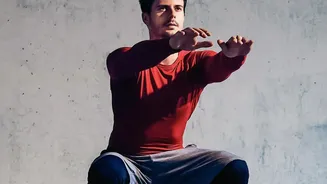
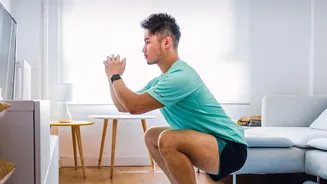
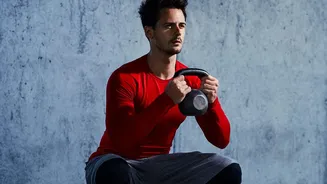
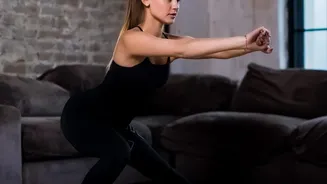
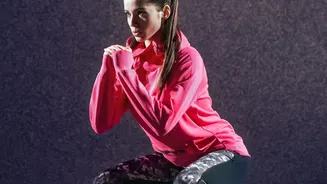
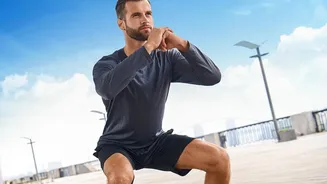
The squat is the foundation of any leg workout. To adjust its difficulty, focus on your form and depth. Start with your feet shoulder-width apart, toes pointing slightly outward. As you lower yourself, keep your chest up and your back straight, pushing your hips back as if sitting in a chair. A beginner might start with a partial squat, lowering only until their thighs are at a 45-degree angle. To increase the difficulty, work on lowering until your thighs are parallel to the floor. The advanced version is the 'ass-to-grass' squat, where you go as low as possible while maintaining a straight back and keeping your heels planted firmly on the ground. Never sacrifice form for depth; if your back starts to round or your heels lift, you've gone too far for your current mobility.
How to Progress Your Squat
Once you are comfortable with full-depth bodyweight squats, you can add difficulty in other ways. One method is to manipulate the tempo. Try a 'tempo squat' by slowing down the movement—take three to four seconds to lower yourself, pause for a second at the bottom, and then take another two seconds to push back up. This increases the time your muscles are under tension. Another great progression is the pause squat, where you hold the bottom position for three to five seconds before rising. For a greater challenge, you can shift your weight to one leg to begin training for single-leg variations, such as shrimp squats or eventually the pistol squat, which represents a significant milestone in bodyweight leg strength.
The Versatility of the Lunge
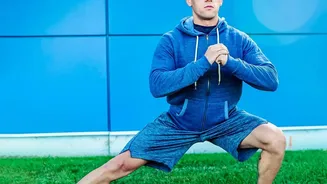
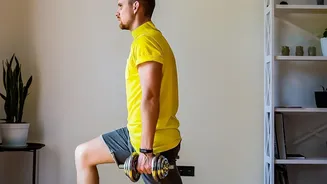
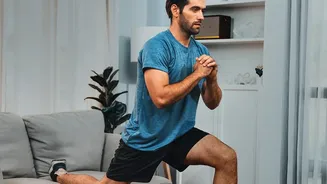
Lunges are excellent for targeting each leg individually, which helps correct muscle imbalances. Similar to squats, the depth of your lunge dictates its difficulty. In a standard forward lunge, step forward and lower your hips until both knees are bent at a 90-degree angle. Ensure your front knee is aligned with your ankle, not drifting past your toes, and that your back knee hovers just above the ground. A shallow lunge where your back knee remains high is easier. To make it harder, sink deeper into the lunge, allowing your back knee to get as close to the floor as possible without touching it. This greater range of motion will intensely challenge your quad, glute, and hamstring muscles.
Advanced Lunge Variations
To further increase the difficulty of your lunges, you can introduce different variations. Reverse lunges, where you step backward instead of forward, are often easier on the knees and place more emphasis on the glutes and hamstrings. Walking lunges add a dynamic component that challenges your balance and coordination. For a significant increase in difficulty, try elevation. A Bulgarian split squat, where your rear foot is elevated on a couch or chair, is a powerful exercise. It increases the load on your front leg and demands more stability, providing a serious challenge to your leg strength and balance without any added weight.