







More Than Just a Satellite
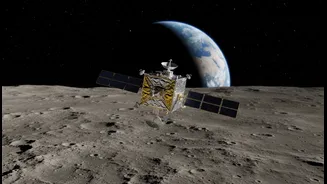
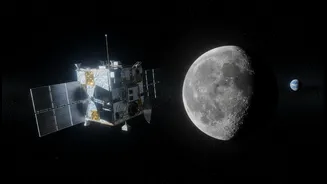
Launched in June 2022, the Cislunar Autonomous Positioning System Technology Operations and Navigation Experiment (CAPSTONE) is a pathfinder mission with a huge job. Its primary task was to be the first spacecraft to enter and operate in a unique near-rectilinear
halo orbit (NRHO) around the Moon. This is the same orbit planned for the Gateway, NASA's future space station that will serve as a staging point for lunar missions under the Artemis program. By flying this path first, the 25kg CubeSat provides critical data to reduce risks and logistical uncertainty for future crewed missions, essentially acting as a scout for the most ambitious lunar program since Apollo.
The Old Way: Navigating with a Time Lag
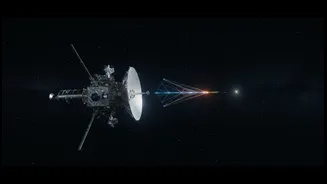
Traditionally, navigating spacecraft in deep space is a painstaking process. It relies almost exclusively on massive radio antennas on Earth, collectively known as the Deep Space Network (DSN). Engineers on the ground send signals to the spacecraft, which then sends them back. Based on the time delay and frequency shift, experts can calculate the spacecraft's position and speed. This method is reliable but has significant drawbacks: it’s slow, expensive, and creates a communications bottleneck as more missions venture into deep space. For a bustling lunar environment with multiple spacecraft, waiting for instructions from Earth for every maneuver is simply not sustainable. It’s like trying to manage city traffic from another continent.
A 'GPS' for the Moon
This is where CAPSTONE’s groundbreaking secondary experiment comes in: the Cislunar Autonomous Positioning System (CAPS). This system is designed to allow spacecraft to determine their position without relying on Earth. CAPS works by communicating with another spacecraft—in this case, NASA’s Lunar Reconnaissance Orbiter (LRO), which has been orbiting the Moon since 2009. CAPSTONE sends a signal to LRO, which then returns it. By measuring the signal's round-trip time, CAPSTONE’s onboard software can calculate its distance from LRO and determine its own position and trajectory. This successful test is a crucial first step towards creating a peer-to-peer navigation network in lunar space, a sort of 'GPS for the Moon' that enables true autonomy.
From Data to Real-Time Decisions
The ability to navigate autonomously is what connects a technology demonstration to real-world engineering decisions. With a system like CAPS, future lunar missions can make critical adjustments on the fly. Imagine a lunar lander needing to change its descent path due to an unexpected hazard, or a Gateway module needing to perform a delicate docking maneuver. Instead of waiting precious minutes or even hours for commands from Mission Control, the spacecraft's own systems could calculate the required adjustments and execute them instantly. This dramatically increases safety, efficiency, and the potential complexity of missions. It also liberates the Deep Space Network to focus on transmitting vital scientific data rather than being tied up with routine navigation tasks.
Paving the Way for a Lunar Economy
The success of CAPSTONE and its CAPS technology is a cornerstone for the entire Artemis program and the future of cislunar development. NASA confirmed that the mission had achieved all its primary and extended objectives by June 2026, validating the orbit for the Gateway and proving that autonomous navigation is viable. This capability is essential not just for NASA but for the growing number of commercial companies planning missions to the Moon. By demonstrating a more efficient, scalable, and independent method of navigation, CAPSTONE is helping to build the foundational infrastructure needed for a sustained human and robotic presence on and around the Moon, ultimately enabling a future lunar economy.