





The Little Satellite That Could
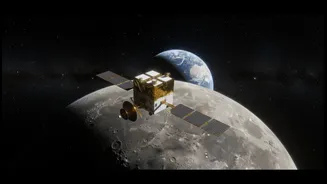
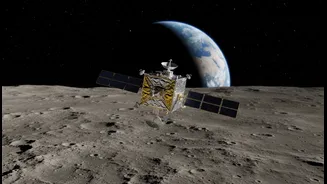
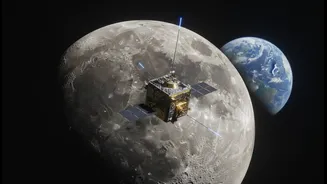
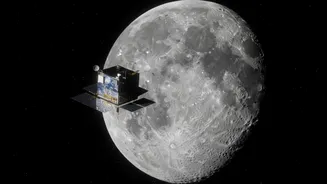
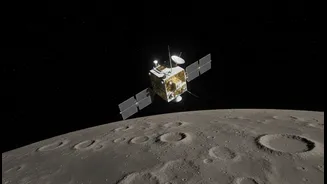
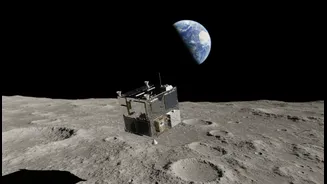
CAPSTONE, short for Cislunar Autonomous Positioning System Technology Operations and Navigation Experiment, is a 55-pound (25 kg) spacecraft that launched in June 2022. It's part of a class of small satellites called CubeSats, which are revolutionizing
space exploration by making missions more affordable and faster to develop. While its size is modest, its mission is anything but. Owned and operated by commercial partner Advanced Space for NASA, CAPSTONE was designed as a pathfinder, a scout sent ahead to test the route for NASA’s ambitious Artemis program, which aims to establish a sustained human presence on and around the Moon.
A Trailblazer's Unique Orbit
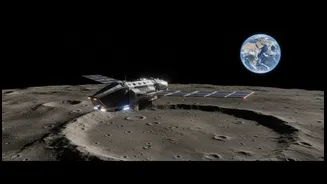
The centerpiece of CAPSTONE's mission was to be the first spacecraft to enter and operate in a special lunar path called a near-rectilinear halo orbit (NRHO). This highly elliptical orbit is located at a precise balance point between the gravities of the Earth and Moon. This unique position offers long-term stability with minimal fuel, making it the ideal location for the future Lunar Gateway, an orbiting outpost that will support astronaut missions. Before committing a massive space station to this path, NASA needed to confirm its models were correct. By successfully flying in this orbit since November 2022, CAPSTONE has verified the route, reducing risk and uncertainty for the multi-billion-dollar Artemis missions.
Building a 'GPS' for the Moon
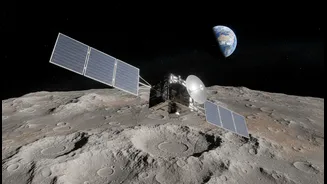
Beyond testing the orbit, CAPSTONE's other major goal was to demonstrate a new, autonomous navigation system. Currently, spacecraft rely on constant communication with giant antennas on Earth to know where they are. CAPSTONE tested a technology called the Cislunar Autonomous Positioning System (CAPS), which allows spacecraft to determine their position by communicating directly with other orbiters, like NASA's Lunar Reconnaissance Orbiter (LRO). This essentially creates a peer-to-peer network, much like a GPS system for the Moon. A successful demonstration means future lunar missions can navigate more independently, freeing up the limited Deep Space Network for crucial science data transmissions instead of routine tracking.
From Primary Mission to Enduring Testbed
CAPSTONE completed its primary six-month mission in May 2023 but its work was far from over. NASA extended its mission, transforming the durable CubeSat into an in-orbit testbed. This extended phase allowed for further testing of autonomous navigation software and advanced communication technologies, like delay/disruption tolerant networking (DTN), which ensures data can be stored and forwarded even with intermittent communication links. The spacecraft became a flexible, cost-effective platform to prove technologies that will be critical for a sustained human presence on the Moon, where constant contact with Earth won't always be possible. After four years of successful operations, NASA concluded its official activities in June 2026, but the spacecraft continues to be operated by Advanced Space as a technology testbed.
The Bigger Story: A New Model for Exploration
The true significance of CAPSTONE lies not just in its technical achievements, but in the model it represents for the future of space exploration. The mission was a collaboration between NASA and several commercial companies, including Advanced Space, Terran Orbital, and Rocket Lab. This partnership allowed for rapid development—from contract to launch in under two years—and a significantly lower cost compared to traditional missions. CAPSTONE has proven that small, commercially-led projects can provide immense value, acting as nimble pioneers that pave the way for larger, more complex endeavors. It lays a foundation for commercial support of future lunar operations and demonstrates a smarter, more sustainable way to explore the cosmos.