






The Orbital Junkyard
Space, particularly low-Earth orbit, is littered with debris. Decades of launches have left a trail of defunct satellites, spent rocket stages, and millions of smaller fragments. According to space agencies, there are thousands of dead satellites and over
100 million smaller bits of junk circling the planet. This isn't just a mess; it's a significant threat. A collision at orbital speeds—which can be as high as 17,500 mph—is catastrophic, creating a cascade of new debris that endangers operational satellites that provide everything from GPS navigation to global communications. The situation is so serious that experts have warned we are approaching a tipping point where certain orbits could become unusable.
A Difficult Cosmic Catch
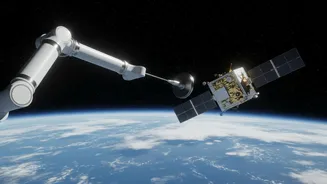
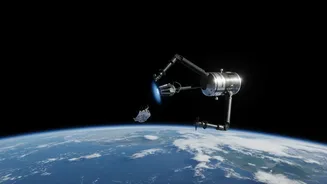
Cleaning up this junk, a process known as Active Debris Removal (ADR), is incredibly challenging. These dead satellites are considered “non-cooperative” targets. They aren't designed to be captured, often lack power, and can be tumbling uncontrollably. Early ideas for ADR involved methods like giant nets or harpoons. While feasible, these kinetic methods come with significant risks. A harpoon strike or a net entanglement could break fragile components, like old solar panels, creating even more small, untrackable debris. Furthermore, physically grabbing a rapidly spinning object with a robotic arm is a high-risk manoeuvre that could damage the capture probe itself.
The Magnetic Solution
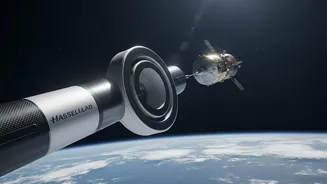
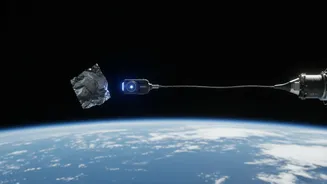
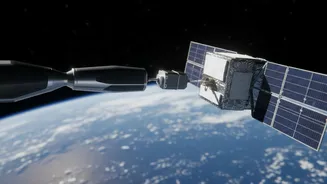
This is where magnetic field tethers offer a more elegant and safer solution. Instead of a forceful, physical grab, this method uses the fundamental principles of electromagnetism to control and capture a target from a safe distance without ever touching it. This “contactless” approach is the key to its appeal. It dramatically reduces the risk of creating new debris during the capture process, making it a much safer option for cleaning up our orbital highways. The technology is being pioneered by companies like Astroscale, whose ELSA-d and upcoming ELSA-M missions are designed to demonstrate the viability of magnetic capture for commercial debris removal.
The Physics of the Pull
The science behind it sounds complex but is based on a principle called eddy currents. Most space debris, even if not naturally magnetic, is made of conductive materials like aluminum or titanium. An ADR probe equipped with a powerful electromagnet approaches the target. As the probe's changing magnetic field passes through the dead satellite's conductive body, it induces small, circulating electrical currents—these are the eddy currents. According to the laws of physics (specifically Lenz's law), these eddy currents create their own magnetic field that opposes the original field from the probe. This opposition generates a gentle force, acting like a brake to slow the target's spin and a tow rope to gently pull it along.
Why Magnets Are a Safer Bet
The primary advantage of using magnetic forces is safety and versatility. The contactless nature of the capture prevents accidental fragmentation. It also allows a probe to synchronize with and stabilize a tumbling object before attempting a secure dock, which is extremely difficult with robotic arms. Another form of this technology, called electrodynamic tethers, uses a long conductive wire to interact with Earth's magnetic field, generating a drag force that can pull debris out of orbit without using propellant. While most current demonstration missions, like Astroscale's ELSA-M, are designed for satellites pre-fitted with a magnetic docking plate, the underlying eddy current technology could one day be used to capture older, unprepared debris. This makes the technology adaptable to a wide range of cleanup scenarios.