
What Exactly Is Solar Wind?
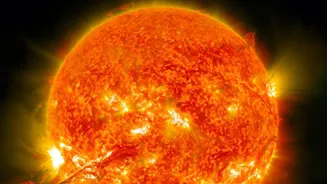
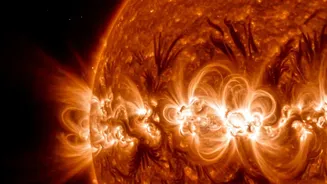
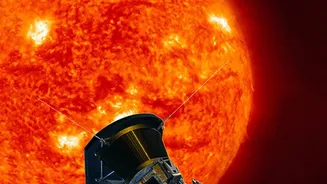
Imagine the Sun not just as a source of light and heat, but as a star that is constantly exhaling. This breath is the solar wind, a continuous stream of charged particles—mostly protons and electrons—flowing outwards from the Sun's incredibly hot outer
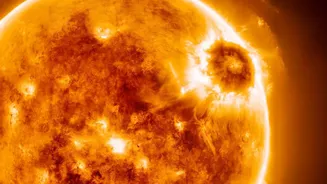
atmosphere, the corona. This isn't a gentle breeze; it's a cosmic river of plasma travelling at speeds that can range from a 'slow' 300 kilometres per second to a blistering 800 kilometres per second or more. This river of particles flows across the entire solar system, bathing all the planets, including Earth. Understanding its dynamics is crucial because powerful gusts and variations in this wind, often triggered by solar events like Coronal Mass Ejections (CMEs), can have significant effects on our planet's magnetic field, a phenomenon known as space weather.
India's Vantage Point at L1
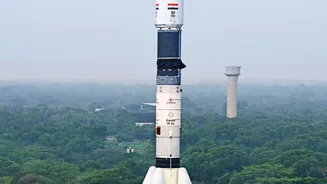
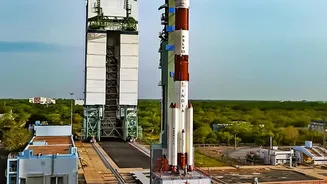
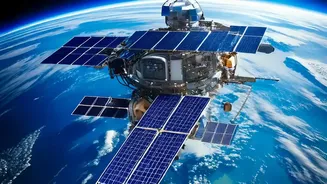
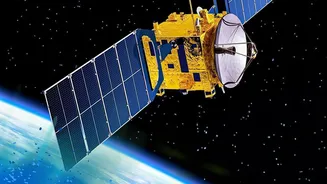
To study this solar wind without interruption, ISRO placed the Aditya-L1 observatory in a special spot 1.5 million kilometres from Earth called the Lagrange Point 1 (L1). From this location, the spacecraft has a continuous, unobstructed view of the Sun. It's like having a dedicated weather station for space, allowing its seven specialised instruments to monitor the Sun's activity and the solar wind around the clock. Three of these payloads are designed for 'in-situ' observations, meaning they directly sample and analyse the particles and magnetic fields that flow past them. This direct measurement is key to understanding the complex dynamics of the solar wind long before it reaches Earth.
The Specialised Particle Detectors
Two key instruments aboard Aditya-L1 are at the forefront of this research: the Aditya Solar wind Particle Experiment (ASPEX) and the Plasma Analyser Package for Aditya (PAPA). Think of them as highly advanced cosmic particle traps. The ASPEX payload contains the Solar Wind Ion Spectrometer (SWIS), which is designed to measure ions like protons and alpha particles, essentially sorting them by energy and direction. The PAPA payload does a similar job, using its two sensors—SWEEP for electrons and SWICAR for ions—to analyse the composition, temperature, and velocity of the solar wind. Together, these instruments create a detailed profile of the solar wind's characteristics, identifying its contents and measuring their speed with incredible precision.
Decoding the Wind's Behaviour
So, what are these sensors revealing? Initial data shows the instruments are performing exceptionally well, successfully identifying the primary components of the solar wind—protons and alpha particles—and distinguishing between them. One of the key early findings from the SWIS instrument is its ability to measure the ratio of alpha particles to protons. Scientists have noted that a change in this ratio can act as a sensitive marker for an incoming Coronal Mass Ejection (CME), a massive eruption of solar plasma. This capability essentially gives us an early warning system for potentially disruptive space weather events. The PAPA instrument has already demonstrated this by successfully detecting the impact of several CMEs, observing an abrupt increase in electron and ion counts that matched data from other international satellites.
Why Solar Wind Velocity Matters
Understanding the velocity and composition of the solar wind isn't just an academic exercise. It has direct, practical implications for our technology-dependent lives on Earth. Sudden changes in solar wind pressure and speed can trigger geomagnetic storms, which have the potential to disrupt satellite communications, damage power grids, and interfere with GPS and navigation systems. By using Aditya-L1's data to understand how these events evolve as they travel from the Sun, scientists can improve space weather forecasting models. More reliable predictions mean that satellite operators, power companies, and airlines can take protective measures, safeguarding critical infrastructure and ensuring the services we rely on every day remain stable and uninterrupted. Aditya-L1's observations are a crucial step in turning space weather prediction from a developing science into a precise, actionable tool.