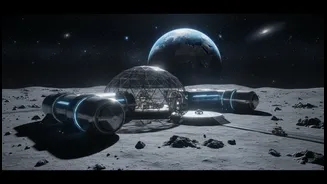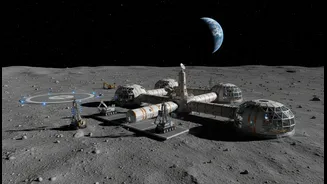









The Grand Plan: A Village on the Moon
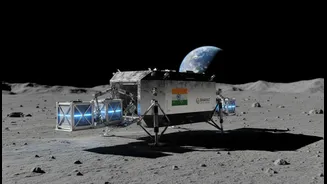
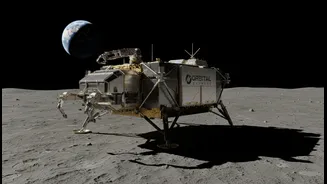
NASA is spearheading the Artemis program, a U.S.-led international effort to return humans to the Moon and establish a sustainable presence. The goal is to build the Artemis Base Camp near the lunar South Pole. This isn't about planting a flag and leaving;
it's about creating a permanent outpost for science, exploration, and eventually, commerce. The plan is unfolding in phases. Phase one, running until about 2029, involves robotic missions, testing technologies, and preparing the surface. Phase two will see the assembly of semi-permanent infrastructure, with the goal of a sustained human presence with routine crew rotations beginning in the 2030s. This long-term vision is what creates a universe of new possibilities.
India's Role: A Key Partner in the Lunar Future
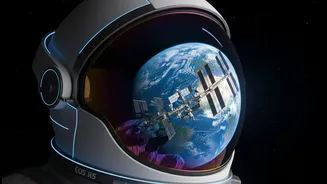
This isn't just a NASA show. India, through the Indian Space Research Organisation (ISRO), has firmly established itself as a major space power. With the historic Chandrayaan-3 landing near the lunar south pole, India became the fourth nation to achieve a soft lunar landing and the first to do so in that region. More importantly, India is a signatory to the Artemis Accords, a set of principles for cooperation in space exploration. This positions India not as a spectator, but as a key stakeholder in the future of lunar development. This partnership facilitates data sharing, technological collaboration, and joint missions, including a potential joint effort to the International Space Station. ISRO also has its own ambitious roadmap, including the Chandrayaan-4 sample return mission and plans for a crewed landing by 2040, all of which will benefit from this international collaboration.
The New Space Economy: More Than Astronauts
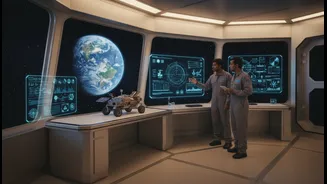
When we think of space careers, we often picture astronauts. But the reality is that for every person in a spaceship, there are thousands on the ground making it happen. The creation of a Moon base will trigger a boom in a new 'space economy'. This burgeoning sector already includes telecommunications, data analytics, cloud computing, and cybersecurity. The demand extends beyond traditional aerospace engineering. Companies will need experts in robotics, materials science, life support systems, renewable energy for lunar power grids, and in-situ resource utilization (using lunar soil to build things). Furthermore, there is a growing need for non-technical professionals in space law, policy, finance, project management, and business development to manage these complex, multinational projects.
The Skills You'll Need to Compete
To be part of this future, you need the right skills. While a foundation in Science, Technology, Engineering, and Mathematics (STEM) is crucial, some areas are in particularly high demand. Software development is the single largest occupation in the space economy, with expertise in languages like Python and C++ for autonomous systems, flight controls, and data analysis being critical. Electrical, RF (Radio Frequency), and embedded systems engineers are also desperately needed to build the communication and hardware infrastructure. Beyond pure engineering, there is a massive demand for data scientists who can interpret the terabytes of information sent back from lunar missions. Even skills from other industries, like automotive software engineering, are highly transferable. Soft skills like communication and teamwork are also vital for international collaboration.
Your Educational and Career Roadmap
So, how can you, a student or young professional in India, get on this path? Start with a strong academic foundation. A bachelor's degree in engineering (aerospace, mechanical, electrical, computer science), physics, or mathematics is a great starting point. Consider specializing at the master's or PhD level in fields like robotics, astrophysics, planetary science, or AI. Top Indian institutions like the IITs and IISc offer world-class programs in these areas. While getting a job directly at NASA can be difficult for non-U.S. citizens, opportunities are opening up through collaborations and research fellowships. The most direct path is through India's own burgeoning space sector. ISRO offers numerous opportunities, and the country's private space industry is growing rapidly, creating a huge demand for skilled professionals.
How to Get Started Today
You don't have to wait until you have a PhD to engage with the space sector. Start now by immersing yourself in the industry. Follow ISRO, NASA, and private space companies on social media and their official websites. Participate in hackathons and competitions like the NASA Space Apps Challenge. Take online courses in programming, data science, or machine learning to build your skillset. Build a portfolio of projects, even small ones, that demonstrate your passion and ability. Network with professionals in the field through online forums and industry events. Gaining relevant experience, even through internships in related fields like robotics or data analytics, can give you a significant edge. The journey to space begins with small, deliberate steps on Earth.