






A Bridge That Breathes
For centuries, the indigenous Khasi and Jaintia communities of Northeast India have cultivated a unique solution to crossing the region's raging rivers. Instead of felling trees for timber that would quickly rot in one of the world's wettest climates,
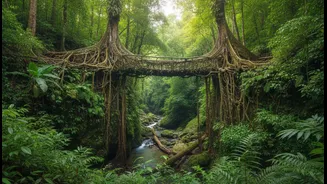
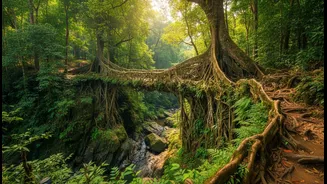
they guide the living aerial roots of the Indian rubber tree (Ficus elastica) across streams. This process, a spectacular display of generational knowledge, involves weaving the pliable roots around temporary bamboo scaffolding or through hollowed-out areca palm trunks. Over 15 to 30 years, these roots thicken, merge, and strengthen, forming a durable, living structure. Unlike concrete and steel, which begin to decay the moment they are completed, these bridges—known as 'jingkieng jri'—only grow stronger with time, with some lasting for hundreds of years and capable of supporting the weight of dozens of people.
Nature's Code: The Essence of Bio-Mimicry
This ancient practice is a perfect example of what modern scientists call bio-mimicry: the art and science of imitating nature's best ideas to solve human problems. From the aerodynamics of a bird's wing inspiring aircraft design to the structure of a termite mound informing energy-efficient buildings, engineers are increasingly looking to the natural world for blueprints. The core idea is that nature, through millions of years of evolution, has already solved many of the challenges we face. Living root bridges are not just a rustic curiosity; they are a sophisticated example of living architecture, embodying principles that cutting-edge structural engineering is only now beginning to fully appreciate.
Lesson 1: Strength Through Adaptation and Growth
Conventional bridges are static. They are built to withstand a calculated maximum load and degrade from there. A living root bridge operates on a completely different principle. It is a dynamic system that responds to its environment. The roots exhibit a property known as 'inosculation', where separate roots growing in close contact graft together to form a single, stronger unit. As the tree grows, it continually adds new roots and reinforces existing ones. This adaptive growth means the bridge becomes more robust over its lifespan, progressively increasing its load-bearing capacity as decades pass. This offers a profound lesson in creating materials and structures that don't just resist stress but actively adapt to it, becoming stronger through use.
Lesson 2: The Power of Self-Repair and Resilience
The maintenance budget for a conventional bridge is a constant battle against corrosion, cracks, and material fatigue. In contrast, a living root bridge has the ability to heal itself. If a root is damaged, the Ficus elastica can compartmentalise the wound and grow new roots to bypass the injury, maintaining the structure's overall integrity. This inherent resilience makes them extraordinarily durable in the face of Meghalaya's extreme weather, where flash floods and violent storms can destroy modern steel bridges. The concept of self-repairing infrastructure is a holy grail for civil engineers, promising reduced lifecycle costs and far greater sustainability. The jingkieng jri demonstrate that this is not science fiction, but a time-tested reality.
Lesson 3: Ultimate Material Efficiency
Nature is the ultimate minimalist, never wasting energy or material. A root bridge exemplifies this. The structure grows exactly where it is needed, distributing forces efficiently across a complex, interwoven network. There is no waste from offcuts, no energy-intensive manufacturing of steel beams or cement. The entire bridge is created from locally available, living material, and even the temporary scaffolding is made from biodegradable bamboo or palm trunks that decompose and return to the ecosystem. Furthermore, as a living structure, the bridge actively sequesters carbon from the atmosphere, making it a carbon-negative technology. It is a model of regenerative design, where the structure not only serves a function but also contributes positively to its environment.
From Ancient Wisdom to Future Cities
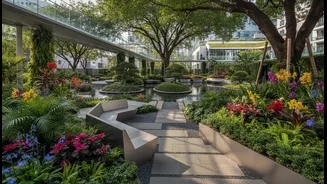
The lessons from these living structures are inspiring a new field of architectural research known as 'Baubotanik' or living plant construction. Researchers are exploring how these principles could be applied in urban settings, imagining buildings with living facades that cool the air, self-repairing structural elements, and a fundamentally symbiotic relationship with their environment. The official submission of Meghalaya's living root bridges for UNESCO World Heritage status further underscores their global significance, not as relics of the past, but as a blueprint for the future. They are a powerful reminder that sometimes the most advanced technology is the one that has been in harmony with nature all along.