
The Perfect Alignment
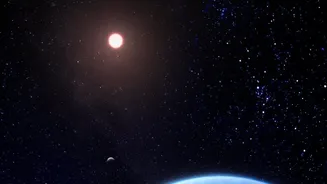
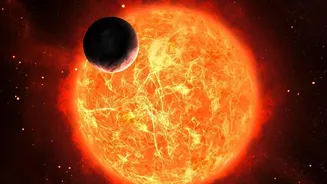
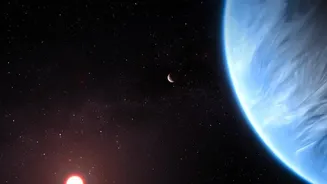
To study a distant planet's atmosphere, astronomers need a bit of cosmic luck. They use a technique called transit spectroscopy, which requires a planet to pass directly in front of its host star from our point of view. This event is called a 'transit'.
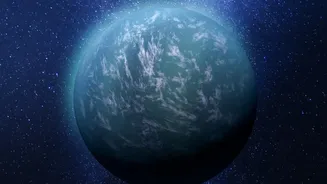
As the exoplanet crosses its star, the star's light dims ever so slightly, a dip that powerful telescopes can detect. But JWST does more than just notice the dimming; it analyzes the starlight that has been filtered through the planet's atmosphere. This tiny sliver of light holds the chemical secrets of that alien world.
Light as a Cosmic Barcode
Think of starlight as a complete rainbow, containing a full spectrum of colours or wavelengths. When this light passes through a planet's atmosphere, the gases present absorb very specific colours. Each molecule, like water (H₂O) or methane (CH₄), has a unique 'fingerprint' or 'barcode'—it absorbs a distinct pattern of light wavelengths. The light that finally reaches the Webb telescope is therefore missing the colours that were absorbed by the atmospheric molecules. By looking for these specific dark lines or gaps in the light's rainbow, scientists can identify exactly what gases are present.
Webb's Specialist Tools
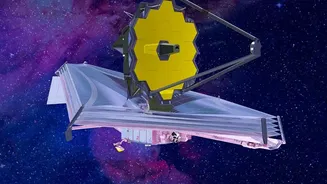
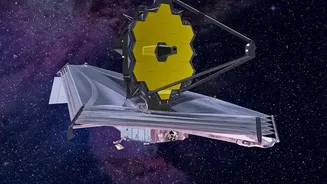
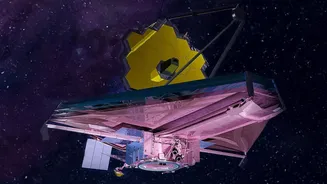
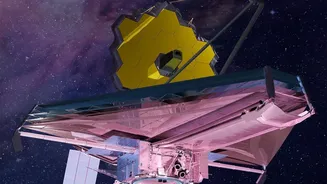
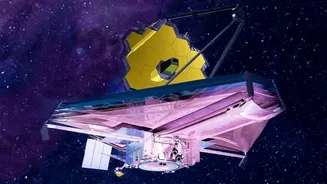
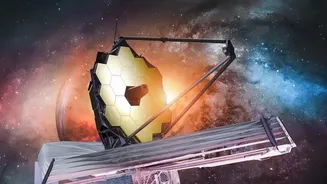
This is where the James Webb Space Telescope's advanced design comes into play. It is equipped with highly sensitive instruments called spectrographs, such as the Near-Infrared Spectrograph (NIRSpec) and the Near-Infrared Imager and Slitless Spectrograph (NIRISS). These instruments are essentially sophisticated prisms that can spread the incoming infrared light—which is invisible to the human eye—into its component wavelengths. They are exceptionally good at detecting the subtle 'barcodes' left by molecules. The detection of water, for instance, has been a major success, with Webb capturing the unambiguous signature of water on planets like WASP-96 b.
Decoding the Data
Once a spectrograph like NIRSpec captures the light spectrum, it doesn't look like a pretty picture but rather a graph with peaks and troughs. The 'troughs' on the graph represent the wavelengths of light that were absorbed by the atmosphere. Scientists compare the observed spectrum with known absorption patterns of different molecules. If the dips in the data perfectly match the known barcode for water vapour, they can confirm its presence. The depth and width of these absorption lines can even help scientists estimate the amount of water in the atmosphere and its temperature.
Challenges and Verification
This process isn't always straightforward. Sometimes, the signal can be ambiguous. For example, astronomers have detected water signatures near some rocky planets, but they have to carefully determine if the water is from the planet's atmosphere or from cool spots on the star itself, which can also contain water vapour. To confirm their findings, scientists often use multiple instruments on Webb, like the Mid-Infrared Instrument (MIRI), to observe the planet from different angles or at different times. This multi-instrument approach helps build a more complete and reliable picture of the exoplanet's atmospheric conditions.
Why Finding Water Matters
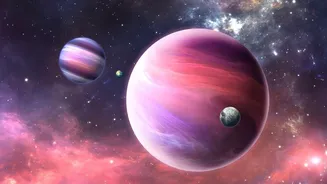
The ability to detect water vapour is a monumental step in the search for habitable worlds beyond our solar system. Water is a key ingredient for life as we know it. While finding water vapour on a scorching 'hot Jupiter' planet doesn't mean it's habitable, it proves that the technology works. These observations are paving the way for Webb to analyze the atmospheres of smaller, rocky, and more Earth-like planets. By perfecting these techniques, astronomers are getting closer to answering one of humanity's biggest questions: are we alone in the universe?