




What Is the 'Blaze Star'?
T Coronae Borealis, or T CrB for short, isn’t just one star but a binary star system located about 3,000 light-years away from Earth. It’s part of the Corona Borealis constellation, also known as the Northern Crown—a small, semicircular arc of stars.
Most of the time, T CrB is far too dim to be seen without a powerful telescope. It sits quietly at a magnitude of +10, which is about 250 times fainter than the faintest stars visible to the naked eye. But this system has a volatile secret that earns it its dramatic nickname, the "Blaze Star." Every 80 years or so, it undergoes a cataclysmic outburst that causes it to brighten dramatically, making it temporarily visible in our night sky.
A 'Recurrent Nova,' Not an Explosion
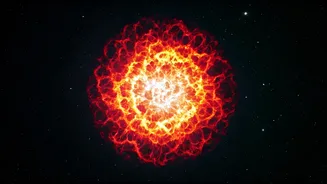
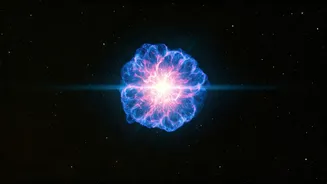
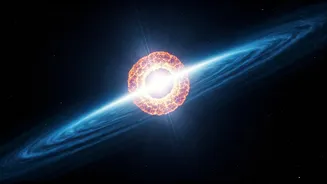
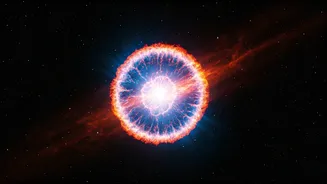
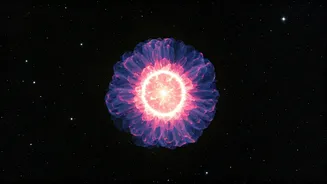
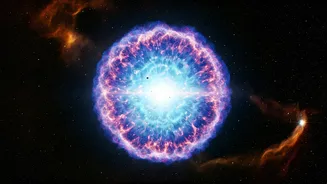
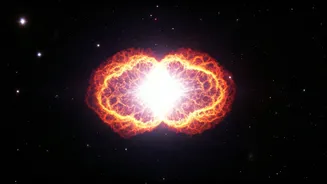
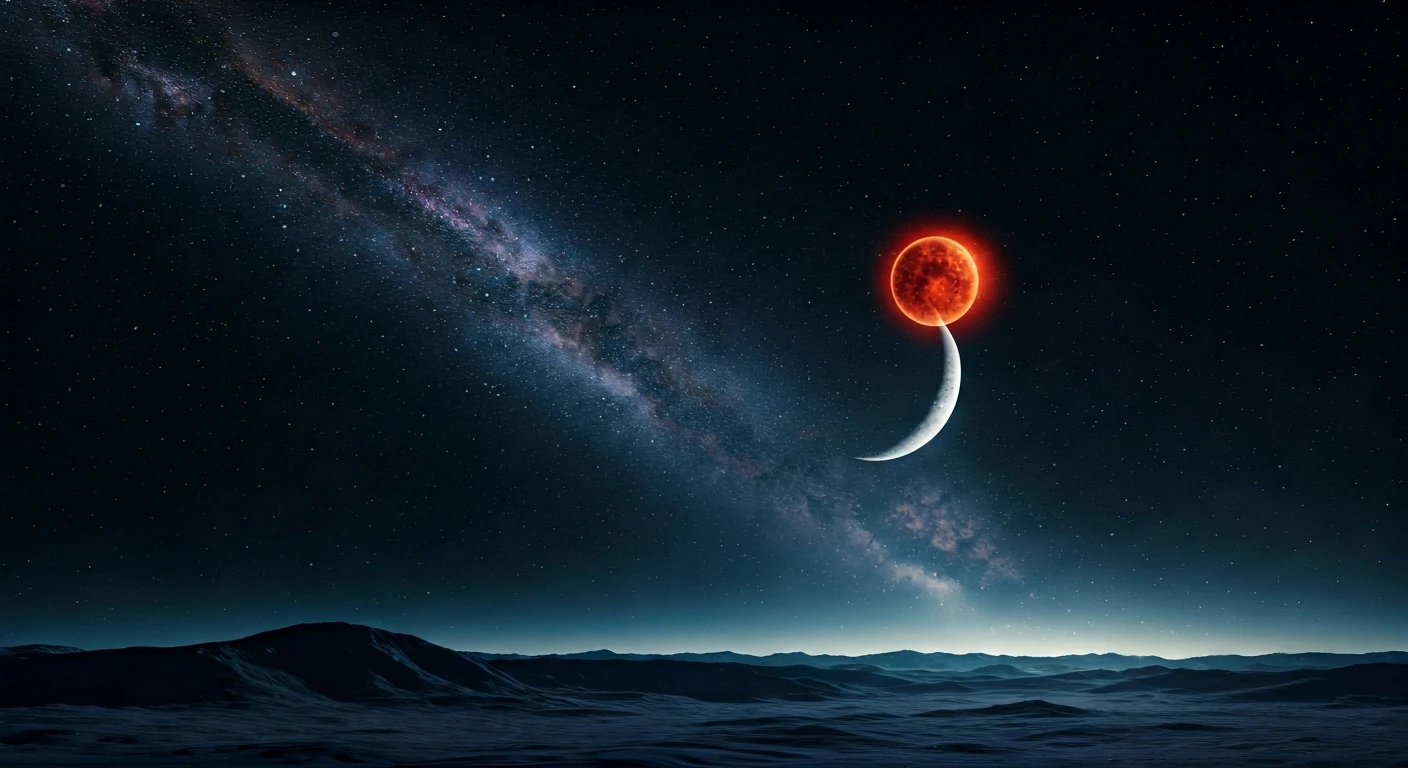
While headlines might use the word "explode," what's happening to T CrB isn't a star-destroying supernova. Instead, it’s a "recurrent nova." The system consists of two stars in a tight orbital dance: a massive red giant and a small, incredibly dense white dwarf. The red giant is constantly shedding its outer layers, and the powerful gravity of the white dwarf pulls this material—mostly hydrogen—onto its own surface. Over decades, this hydrogen accumulates, getting hotter and denser. Eventually, it reaches a critical point, triggering a runaway thermonuclear reaction. This reaction is what we see as the nova: a brilliant flash of light that increases the system's brightness by a factor of more than 1,500. The underlying stars survive the event, and the cycle begins all over again.
The Once-in-a-Lifetime Countdown
This isn't a new phenomenon. T CrB’s outbursts were recorded by astronomers in 1866 and most recently in 1946. Following its roughly 80-year cycle, astronomers have been on high alert, predicting the next nova event for 2024. NASA and other space agencies have confirmed that the system has already begun showing pre-eruption signs, similar to those observed before the 1946 event. While the exact date is impossible to predict—hence the "any day" excitement—the scientific window is firm: the nova is expected to occur sometime between now and September 2024. This makes every clear night a potential front-row seat to the show. For most people alive today, this will be the only time they get to see it.
How to See It From India
The good news is this celestial event will be visible from the Northern Hemisphere, including all of India. Once the nova erupts, T CrB will brighten from its usual faintness to a magnitude of about +2. This will make it as bright as Polaris, the North Star, and easily visible to the naked eye, even in areas with some light pollution. To find it, you’ll first need to locate the constellation Corona Borealis. It's a small, C-shaped pattern of stars nestled between the larger constellations of Boötes (marked by the bright star Arcturus) and Hercules. The "new" star will appear within this arc. Your best bet is to find a spot with a clear view of the sky, away from the worst of city lights. The nova will likely remain visible for a few days to a week before it begins to fade back into obscurity for another 80 years.
What Makes This Event So Special?
In an age of high-definition space telescopes, there is something profoundly magical about a cosmic event you can witness with your own eyes. There are only about ten known recurrent novae in our galaxy, and T CrB is one of the closest and brightest. Its eruption is a reminder of the dynamic, ever-changing nature of the universe. It connects us to the past—to the sky-watchers of 1946 and 1866 who marvelled at the same "new" star. And it provides a rare, shared experience. People all across India and the Northern Hemisphere will be able to look up and see the same sudden beacon of light, a temporary visitor in our familiar celestial neighbourhood. It's a fleeting, beautiful, and powerful spectacle.