


Venus: A World of Extremes
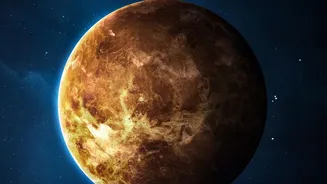
Imagine a planet roughly the same size as Earth, but with a surface hot enough to melt lead and an atmospheric pressure over 90 times greater than what we experience at sea level. That’s Venus. Its thick atmosphere is dominated by carbon dioxide, creating
a runaway greenhouse effect, and it’s completely covered by opaque clouds of sulfuric acid. This hostile environment makes Venus incredibly difficult to study, but also deeply fascinating. Scientists believe it may have once been more like Earth, possibly with liquid water, but something caused a dramatic climate shift. Understanding how and why Venus became so inhospitable is a key scientific goal, as it could offer crucial insights into planetary evolution and climate change on our own world.
Enter Shukrayaan-1: India's Venus Orbiter
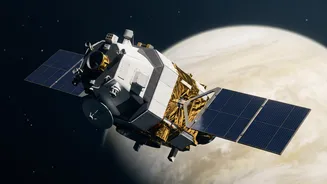
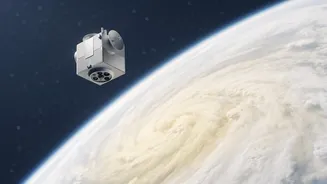
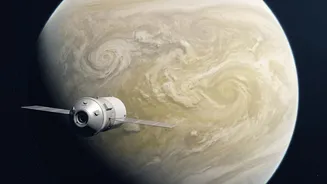
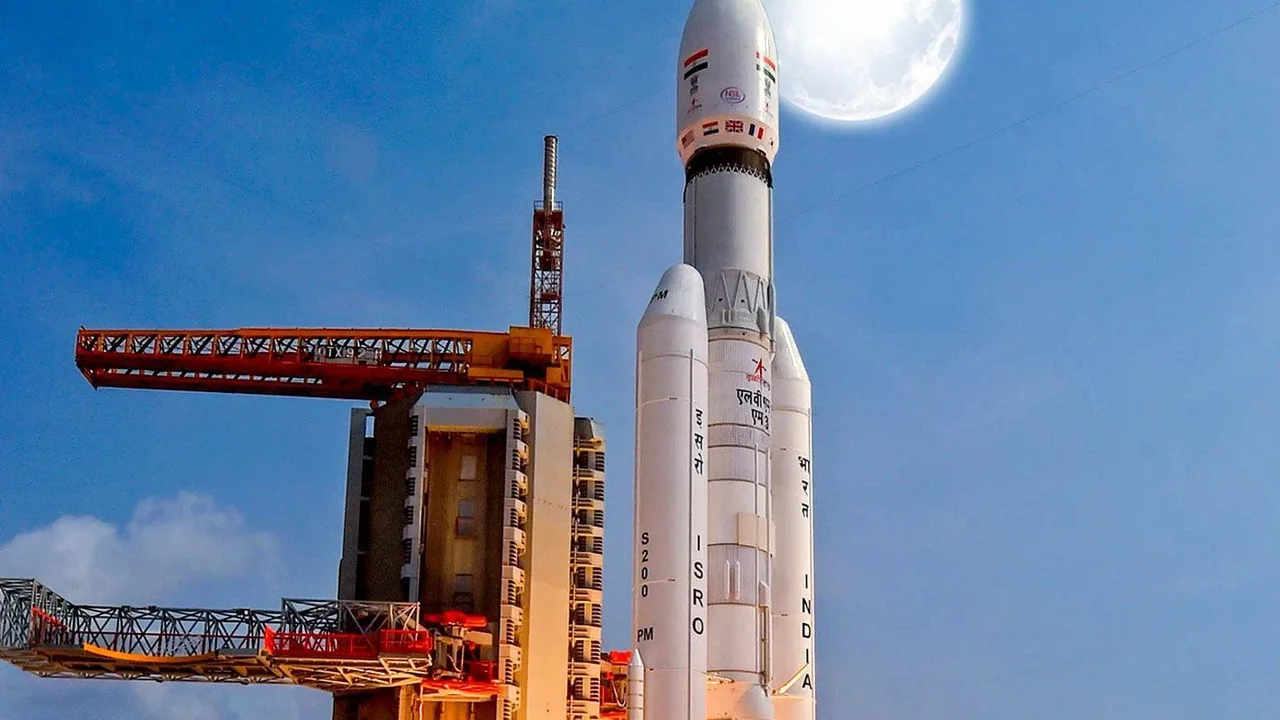
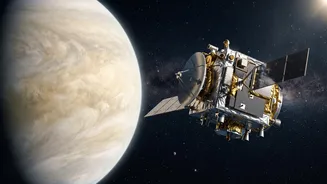
To tackle these questions, ISRO is developing the Venus Orbiter Mission, known as Shukrayaan-1. Scheduled for a potential launch in March 2028, this orbiter is India's first dedicated mission to our planetary neighbour. The spacecraft won't attempt to land—a feat incredibly challenging due to the extreme surface conditions—but will instead enter a highly elliptical orbit. From this vantage point, its sophisticated suite of instruments will spend years mapping the planet’s surface and, most critically, analyzing its dense, complex atmosphere. The mission follows in the footsteps of ISRO's successful Mars Orbiter Mission (Mangalyaan), further cementing India's status as a major player in interplanetary exploration.
The Eyes and Nose of the Mission
The success of Shukrayaan-1 hinges on its powerful sensors, designed to peer through the thick clouds and sniff out chemical clues. One of the key instruments is the Venus Infrared Atmospheric Gases Linker (VIRAL), a collaborative payload with Russia and France. This sensor will analyze the composition of the atmosphere to map the distribution of key gases like carbon dioxide and sulfuric acid. Another crucial instrument, the Venusian Neutrals Analyzer (VNA), provided by Sweden, will study how the solar wind strips away atmospheric particles. This process could explain how Venus lost any water it might have once had.
Hunting for Volcanic Clues and Signs of Life
Beyond general atmospheric study, the sensors have very specific targets. Shukrayaan will carry spectrometers designed to look for the chemical fingerprints of various gases in infrared and ultraviolet wavelengths. These instruments will search for evidence of active volcanism by detecting hotspots and specific gases released by eruptions. The mission will also investigate one of the most intriguing, though contested, discoveries about Venus: the potential presence of phosphine gas. On Earth, phosphine is associated with biological processes, so the VIRAL instrument will carefully search for this molecule, which could hint at either unknown chemical reactions or, more speculatively, microbial life in the clouds.
Seeing Through the Clouds
Studying chemical processes in the atmosphere is only half the story. To get a complete picture, Shukrayaan will also be equipped with advanced radar systems. A high-resolution Synthetic Aperture Radar (SAR) will pierce through the dense cloud cover to map the Venusian surface with a resolution up to four times better than NASA's Magellan mission in the 1990s. In a groundbreaking first for Venus exploration, ISRO also plans to include a ground-penetrating radar. This instrument will allow scientists to study the shallow subsurface for the first time, providing a glimpse into the planet's geological layers and history.