




A Call from the Void Goes Garbled
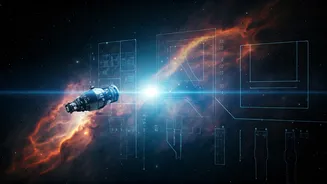
In November 2023, a strange thing happened at NASA's Jet Propulsion Laboratory (JPL). The data stream from Voyager 1, a stalwart explorer of the cosmos for nearly half a century, stopped making sense. Instead of valuable scientific readings from beyond
our solar system, the probe was sending back a monotonous, repeating pattern of code—effectively a dial tone from the darkness of interstellar space. The spacecraft was still alive; it was receiving commands and clearly operating. But its ability to report back on its health or its discoveries about the universe had vanished. For a mission that has been rewriting textbooks since its 1977 launch, it was a silent, baffling crisis.
The Long-Distance Diagnosis
Troubleshooting a machine in the next room is one thing; diagnosing one that is 24 billion kilometres away is another entirely. Every message sent to Voyager 1 takes more than 22 hours to arrive, and a response takes the same time to travel back. Sending a command and seeing the result is a two-day commitment. For months, the engineering team worked through this painstaking process. They sent a 'poke' command to the spacecraft, asking one of its three onboard computers, the Flight Data Subsystem (FDS), to send a full readout of its memory. The answer, when it finally arrived, pinpointed the problem: a single, faulty memory chip. This one tiny component, responsible for just 3% of the FDS memory, had failed, taking with it the crucial code needed to package and send data.
Digital Surgery on 1970s Hardware
On Earth, you would simply replace the chip. But in the void between stars, that is impossible. The JPL team had to devise one of the most audacious remote repairs ever attempted. The plan was not to fix the broken chip, but to work around it. They would move the affected software to other locations in the computer's memory. The challenge? The computer, a relic from the 1970s, has only about 68 kilobytes of memory in total—a microscopic fraction of a modern smartphone's capacity. There wasn't a single empty spot large enough to hold all the displaced code. So, the engineers performed a feat of digital surgery. They carefully broke the code into smaller fragments, tucking each piece into various unused sections of memory. They then rewrote the program's instructions so that all these scattered pieces would still work together seamlessly. It was like taking a critical paragraph from a book, tearing it into individual words, pasting them into the margins of other pages, and then creating a new index so a reader could still piece the original paragraph together.
A Priceless Return on Ingenuity
On April 18, 2024, the command to activate this intricate workaround was sent across the solar system. Two days later, on April 20, the team received a signal that was no longer gibberish. For the first time in five months, they received a clean, readable status update from Voyager 1. By June, all four of the probe's still-operating science instruments were back online, resuming their invaluable work. While the headline figure of $30 million is difficult to assign to this specific repair, the value of saving this historic mission is incalculable. It represents countless hours of brilliant engineering and the preservation of an irreplaceable scientific asset. This fix wasn't about cost; it was about protecting a legacy and continuing humanity’s longest conversation with the cosmos. The ingenuity displayed by the NASA team delivered a return that no budget can fully capture.