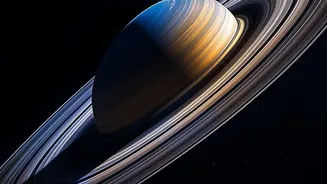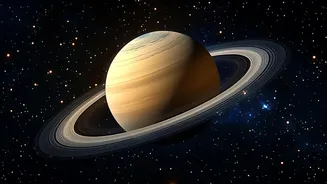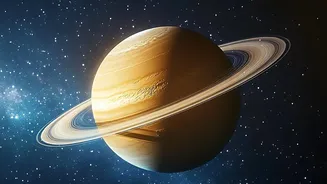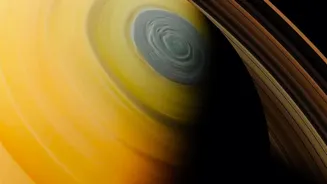




Set Your Expectations
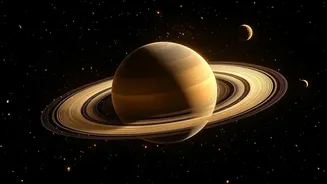
Before you point any optics at the sky, it's crucial to manage your expectations. The view of Saturn through a backyard telescope will not look like a crisp, colossal image from the Hubble Space Telescope. It will be small, and the details can be subtle.
However, the thrill comes from seeing the real thing—a planet over a billion kilometres away—with your own eyes. The image will be a tiny, perfect jewel, and its reality is far more awe-inspiring than any photograph. Many veteran astronomers get hooked on the hobby after their first gasp-inducing look at the ringed planet.
Find the Right Time and Place
Saturn is one of five planets visible to the naked eye, appearing as a bright, steady, yellowish point of light that doesn't twinkle like a star. For those in the Northern Hemisphere, late 2026 offers a fantastic opportunity. On October 4, 2026, Saturn reaches opposition, meaning Earth will be directly between Saturn and the Sun. During this period, the planet rises around sunset and is visible all night, making it brighter and appear larger than at any other time of the year. To locate it, look to the eastern sky after dark. Using a free stargazing app on your phone can pinpoint its exact location in seconds.
Choosing Your Gear: Binoculars or Telescope?
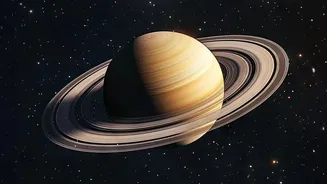
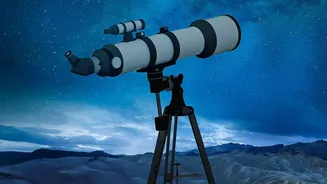
You don't need a powerful observatory to see Saturn's most famous feature. A good pair of stargazing binoculars (such as 10x50s) mounted on a tripod for stability will reveal Saturn not as a point, but as a distinctly elongated or oval-shaped 'star'—your first hint of the rings. You might even spot its largest moon, Titan, as a faint dot nearby.To truly see the rings as separate from the planet, you'll need a telescope. The good news is that almost any telescope will do the job. A small telescope with just 25x to 50x magnification will clearly show the rings as a distinct structure. A beginner telescope, such as a 60mm refractor, is enough to get that first, unforgettable view. At this power, they might look like tiny 'ears' on the side of the planet.
Dialing in the View
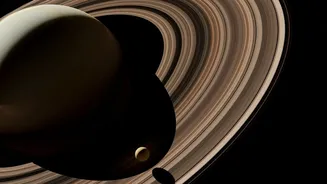
Once you have Saturn in your sights with a telescope, the real fun begins. Start with your lowest-power eyepiece (like a 25mm) to find and centre the planet. Then, you can switch to a higher-power eyepiece (9mm, for example) to increase magnification. A magnification of around 50x to 100x is the sweet spot for a clear view of the rings on most nights. Through a 3-inch or 4-inch telescope, you should be able to see the planet's globe and the rings detached on all sides. You might also notice the planet's shadow falling across the rings, which gives the view a stunning 3D appearance.
Patience and the Art of 'Seeing'
Sometimes, the biggest challenge isn't your equipment, but the Earth's atmosphere. Astronomers refer to atmospheric stability as 'seeing'. On nights of poor seeing, the air is turbulent, causing the image of Saturn to shimmer or blur, hiding fine details. On a night of good, steady seeing, the details will pop. Be patient. Your eyes also need about 20-30 minutes to fully adapt to the darkness, which will help you see more detail. Avoid looking at your bright phone screen. If you need to use a light, use a red flashlight to preserve your night vision. Let the image 'float' into focus during moments of atmospheric stillness. Those fleeting moments of perfect clarity are what stargazers live for.