





The Handloom vs. Power Loom Basics
Before diving into details, it is essential to understand the fundamental difference. A handloom saree is woven entirely by a person on a loom without the use of electricity. This manual process is slow and requires immense skill, meaning each saree has
subtle, unique characteristics. A power loom, on the other hand, is an automated, electric-powered machine that produces fabric much faster. The result is a perfectly uniform product. The problem is not that power looms exist, but when machine-made sarees are dishonestly sold at handloom prices, it cheats both the buyer and the weaver.
Embrace the 'Imperfections'
The signature of a genuine handloom saree lies in its minor irregularities. Because it is made by a human and not a machine, you will find slight variations in the weave's tightness, the spacing of motifs, or the alignment of a border. These are not defects but proof of human craftsmanship. A machine-made saree will look flawless and perfectly symmetrical, which is a key giveaway. If every single motif is an exact replica of the next, be sceptical. The slight, living irregularity is the 'signature' of the weaver.
Turn It Over: The Reverse Story
One of the most telling tests is to flip the saree over and examine the back. In a handwoven piece, especially a brocade like a Banarasi, the reverse side of the motifs will show the weave structure, including floats or small, tied-off thread knots. Power looms carry the extra weft threads across the fabric mechanically, often resulting in a very different-looking back, either completely flat or with long, loose floats that are later clipped. If the reverse side is too neat and clean compared to an elaborate front, it is likely a machine-made fabric.
Feel the Fabric and Check the Edges
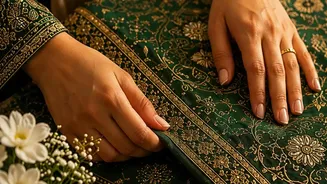
A handloom saree feels different. The fabric is often softer, more breathable, and has more 'body' than its machine-made counterparts, which can feel stiff. Run your hand across the surface; authentic handloom fabric has a subtle, organic texture, while power loom fabric can feel flat and uniform. Another clue is the selvedge, or the finished edges of the saree. Handloom weaving often leaves tiny pin marks or holes at regular intervals along the edges where the saree was pinned to the loom. The selvedge itself may also be slightly uneven, unlike the perfectly straight edges of a power loom fabric.
A Look at Specific Weaves
Knowing the characteristics of a few famous weaves can be incredibly helpful. For a Kanjivaram, look for the 'korvai' technique, where the border and body are woven separately and then interlocked, creating a distinct, slightly jagged join you can feel. For a Banarasi, the intricate Mughal-inspired zari motifs are key; the reverse side will show the hand-tied knots of the 'Kadhwa' technique. For a Jamdani, the motifs appear to float on a sheer background. This is because they are woven directly into the fabric using a supplementary weft technique, a painstaking process no machine can replicate.
Look for Official Certification
To add a layer of security, look for official certifications. The Government of India provides the 'Handloom Mark', a label that certifies a product as genuinely handwoven. For silk sarees, the 'Silk Mark' guarantees that the material used is 100% natural silk. Many regional weaves also have a Geographical Indication (GI) tag, which confirms that the saree was made in its specific geographical region using traditional methods, such as those for Banarasi or Kanjivaram sarees. A reputable seller should be able to provide information about these certifications.