




A New Geometric Marvel
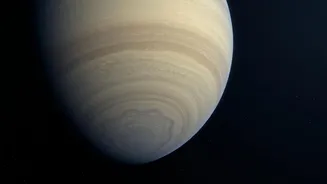
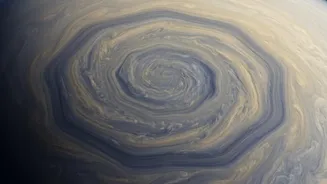
In a stunning revelation, recent images from the Hubble Space Telescope have confirmed the existence of a massive, 10-sided atmospheric wave, or decagon, churning around Saturn's south pole. This is the first time scientists have ever observed such a large,
regular-sided jet stream pattern in the planet's southern hemisphere. The discovery was made possible as Saturn's long, 29-year orbit and seasonal tilt brought the south pole back into view from Earth after years in shadow. Faint hints of the structure were first spotted by amateur astronomers in 2024, leading to dedicated observation time with Hubble, which confirmed the feature's presence in data going back to 2023.
More Than Just a Pretty Shape
This isn't just a cloud pattern; it's a colossal atmospheric wave embedded within one of Saturn's powerful jet streams. By observing the planet through different light filters, which probe various altitudes, scientists have determined that the decagon is a towering structure, extending deep into the planet's atmosphere. Unlike a simple storm, this geometric pattern is thought to be a standing wave, a phenomenon created when the jet stream is forced into a stable, repeating shape by complex atmospheric dynamics. The exact mechanism is still under investigation, but it involves the delicate balance of wind speeds and pressures deep within the gas giant.
The South Pole's Answer to the Hexagon?
For years, the main event on Saturn has been the famous hexagon at its north pole, a six-sided storm wider than two Earths that has been stable for over 40 years. Scientists had long searched for a southern counterpart, but NASA's Cassini mission, which orbited Saturn from 2004 to 2017, found no such long-lived geometric feature. The south pole did have a large, circular vortex, but nothing like the rigid shape of the hexagon. This new decagon is both similar and strangely different. Its recent formation—seemingly within the last few years—suggests that the conditions that create these polygons might be more widespread, yet more dynamic, than previously believed.
Why Ten Sides, and Why Now?
The sudden appearance of the decagon is the biggest puzzle for planetary scientists. While computer models have shown that polygonal shapes can form in rotating fluids, the specific conditions that lead to ten sides instead of six are unknown. One theory is that a powerful storm or vortex, first observed darkening in 2025, may have provided the initial disturbance needed to trigger the wave pattern in the jet stream. Unlike the seemingly permanent northern hexagon, this southern decagon appears to be evolving, giving scientists a rare, real-time look at how these giant planetary features form, strengthen, and perhaps, one day, disappear.
What Happens Next?
The discovery opens a new chapter in our understanding of planetary atmospheres. It challenges the idea that the northern hexagon was a complete one-off. Researchers will continue to monitor the south pole using both Hubble and the James Webb Space Telescope, tracking the decagon's stability, temperature, and movement. These observations, combined with sophisticated computer simulations, will help unravel the physics behind its formation. Studying this new wave can provide crucial insights into the atmospheric engines of gas giants and even help us understand the fundamental principles that govern weather systems on planets throughout our solar system and beyond.