





The Core of the Matter
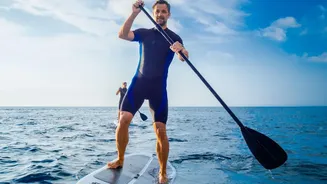
Both activities are praised for their core-strengthening benefits, but they work your midsection in different ways. Stand-up paddleboarding is, at its heart, a balancing act. From the moment you stand on the board, your deep core muscles, abs, and lower
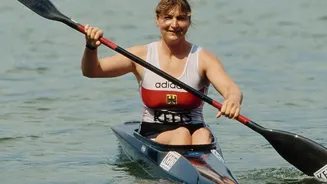
back are constantly firing to keep you stable on an unstable surface. This creates a sustained, low-level isometric workout for your entire core. Kayaking also demands a strong core, but in a more dynamic way. A proper kayaking stroke isn't pulled with the arms; it's a rotational movement driven by your torso. This means your obliques and abdominal muscles are engaged in a powerful twisting motion with every stroke, building rotational strength.
An Upper-Body Showdown
If your goal is to build upper-body strength and endurance, kayaking has a distinct edge. The motion of pulling a double-bladed paddle through the water provides a significant workout for your back, shoulders, and arms. The latissimus dorsi (lats), deltoids, biceps, and triceps are all heavily recruited. While paddleboarding also works the upper body, the nature of the single-bladed paddle stroke tends to be less demanding on the arms and more integrated with the core and legs. Kayaking isolates and intensely works the 'pulling' muscles of the upper body, making it the more focused upper-body workout of the two.
The Lower-Body Question
Here, paddleboarding wins by a wide margin. In a kayak, your legs are primarily used for bracing and balance, pressing against footpegs to help transfer power from your core to the paddle. While they are engaged, it's not a primary workout. On a paddleboard, your legs are your foundation. They are in a constant state of engagement, with the small stabilising muscles in your ankles, knees, and hips working overtime to adjust to the water's movement. Your glutes, quads, and hamstrings are isometrically contracted to hold a slight squat, providing a consistent lower-body workout that kayaking simply doesn't offer from its seated position.
Which Burns More Calories?
Calorie burn depends heavily on intensity, pace, and water conditions. However, studies and estimates suggest that paddleboarding often has a higher potential for burning calories. A casual hour of kayaking might burn between 300 to 400 calories. In contrast, an hour of paddleboarding can burn anywhere from 400 to 700 calories. The higher number for SUP is largely because it's a genuine full-body workout, engaging more muscle groups simultaneously—especially the large muscles of the legs and core—just to stay balanced. That said, an intense, high-paced kayaking session will certainly burn more calories than a lazy, leisurely float on a paddleboard.
Beginner Friendliness and Stability
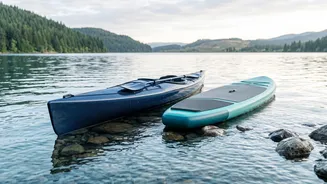
For the absolute beginner, kayaking is often considered easier to learn. The seated position provides a low centre of gravity, making the boat feel very stable and removing the major challenge of balancing on your feet. You can get in and start paddling with minimal instruction. Paddleboarding has a slightly steeper learning curve, as finding your balance can take some practice. However, modern inflatable paddleboards are typically wide and very stable, making it easier than ever for newcomers to stand up within their first session. Your choice may come down to whether you prefer the security of sitting or the challenge of standing.