




Beyond the 'Just Right' Distance
The concept of a habitable zone, a region around a star where a planet is not too hot and not too cold, has long been the primary guide in our search for alien worlds. It’s an intuitive idea that has successfully narrowed down thousands of exoplanets
to a handful of promising candidates. However, recent discoveries and advanced modelling have shown that a planet’s address is only one piece of the puzzle. True habitability depends on a delicate and complex interplay of factors, including the path it travels, the air it breathes, and the temperament of the star it calls home. A planet could be in the perfect location, but if these other conditions aren't met, the chances for life diminish dramatically. This deeper understanding is forcing a rethink of where and how we search for life in the cosmos.
The Planetary Dance of Orbit
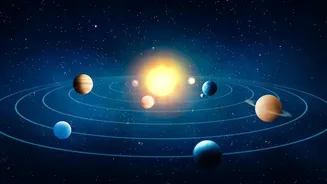
Not all orbits are created equal. A planet with a stable, near-circular orbit like Earth's experiences relatively consistent temperatures. But many exoplanets travel on highly eccentric, or oval-shaped, paths. This means they swing very close to their star before moving far away, leading to extreme seasonal temperature shifts. Imagine a world where summers are hot enough to boil oceans and winters are cold enough to freeze carbon dioxide from the air. While some studies suggest a moderately eccentric orbit could surprisingly enhance habitability by warming the planet and distributing precipitation more evenly, a very large eccentricity could make conditions too volatile for life to gain a foothold. The stability of a planetary system matters, too; planets whose orbits are disturbed by giant neighbours can be thrown into chaotic climate cycles or ejected from the system entirely.
The All-Important Atmospheric Shield
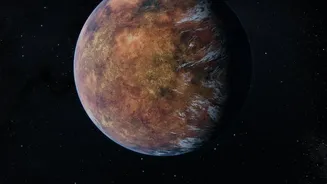
An atmosphere does much more than just provide air to breathe; it's a planet’s first line of defense and its climate control system. A sufficiently dense atmosphere is needed to protect the surface from harmful ultraviolet and X-ray radiation from its star. It also traps heat through the greenhouse effect, keeping the surface warm enough for liquid water. However, the planet's size is critical. If a planet is too small, its gravity won't be strong enough to hold onto its atmosphere, which can be stripped away by powerful stellar winds over millions of years. If a planet is too large, it might accumulate a crushing, hydrogen-heavy atmosphere not suitable for life as we know it. The presence of a magnetic field, generated by a molten core, is also vital to shield the atmosphere from being eroded by its star's constant stream of charged particles.
When a Star Has a Temper
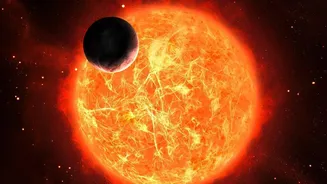
The host star itself plays a defining role. While sun-like stars offer a degree of stability, many potentially habitable planets orbit smaller, cooler red dwarf stars. These stars make up about 75% of our galaxy's stellar population, but they come with a major drawback: they are prone to frequent and violent flares. These outbursts can unleash massive amounts of high-energy radiation, potentially sterilizing the surface of a nearby planet and stripping away its atmosphere over time. Research shows these flares can dramatically alter a planet's atmospheric chemistry, deplete its protective ozone layer, and create extreme weather variability. While a star provides the energy for life, a star that is too active can just as easily prevent it from ever beginning, making stellar behavior a critical checkpoint in the search for habitable worlds.