




An Audacious Goal: Flight on Another World
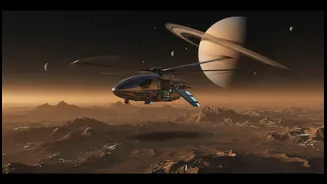
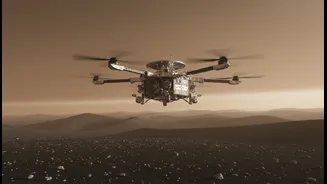
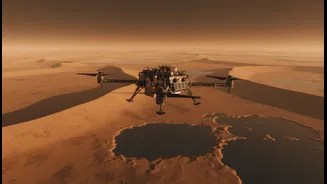
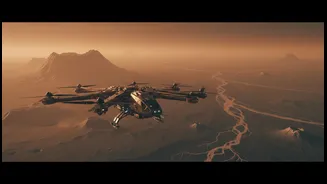
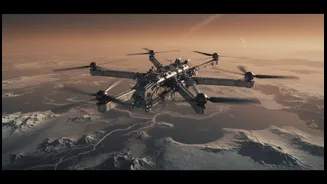
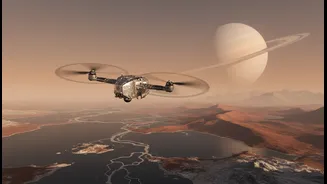
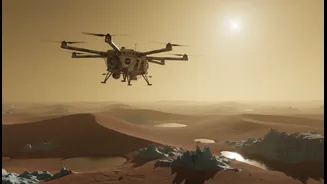
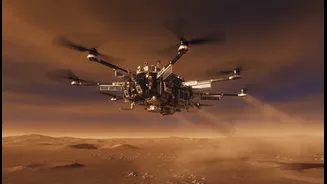
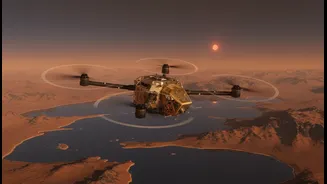
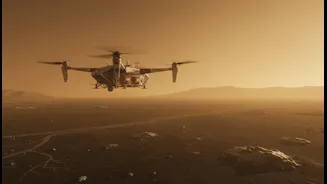
Set to launch in 2028 and arrive on Titan in the mid-2030s, Dragonfly is unlike any mission before it. For over three years, this nuclear-powered octocopter is designed to fly across the moon's surface, making a series of leapfrog-style hops to explore
diverse locations. The goal is to study Titan's complex, carbon-rich chemistry, which scientists believe could offer clues about the building blocks of life. Titan is an astrobiologist's dream: a world with a thick atmosphere, weather, and rivers and lakes of liquid methane. By being able to fly from place to place—covering more ground in its mission than all previous Mars rovers combined—Dragonfly promises to revolutionize our understanding of this unique moon.
The Peculiarities of Titan's Skies
Flying on Titan is, in some ways, easier than on Earth. Its atmosphere is about four times denser than our own, while its gravity is just one-seventh of what we experience. This combination of high density and low gravity is perfect for a rotorcraft, providing plenty of lift. However, this is where the simplicity ends. The atmosphere is extremely cold, with surface temperatures dipping to around minus 180 degrees Celsius. The air itself is a soupy mix of nitrogen and methane, creating a thick, orange haze. Wind patterns, turbulence, and even potential methane rain are all factors that are not fully understood. This alien environment presents a monumental challenge for engineers trying to predict how a rotorcraft will behave billions of kilometres from home.
The Simulation Sticking Point
This is where the headline's 'key limit' comes into play. Because it is impossible to perfectly replicate Titan's environment on Earth, NASA relies heavily on computer simulations and aerodynamic models. These models are crucial for everything: designing the rotors, predicting power consumption, and programming the autonomous flight software that will guide Dragonfly safely. However, the data to build these models is limited. Our primary source of on-the-ground atmospheric data comes from the Huygens probe, which descended through Titan's atmosphere in 2005. While groundbreaking, this was a one-shot data point. The Dragonfly team has to extrapolate from this, combined with data from the Cassini orbiter, to build a comprehensive model of flight dynamics. Every aspect, from how the eight rotors will interact with the dense air to how the vehicle will handle an unexpected gust of wind near a crater wall, must be simulated with extreme confidence.
Forging a Path Through Uncertainty
To overcome this, NASA and its partners at the Johns Hopkins Applied Physics Laboratory are engaged in a painstaking process of testing and validation. They test components in specialized chambers that mimic Titan's extreme cold and pressure. They conduct wind tunnel tests using gases that simulate the density of Titan's air. And they run thousands of 'Monte Carlo' simulations, which are a type of computational analysis that introduces random variables to test the robustness of the system against a wide range of potential conditions. Each test, whether physical or digital, refines the models, inching them closer to a version that can be trusted to fly autonomously on another world. While physical assembly of the spacecraft is well underway, with major structural tests completed recently, the work on perfecting these flight models continues in parallel. The success of the entire mission depends on getting this digital blueprint of Titan's skies right.