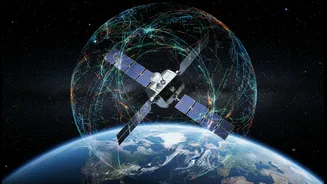









The New Orbital Marketplace
Low Earth Orbit (LEO) is transforming from a domain of government-led exploration into a bustling commercial marketplace. As launch costs plummet thanks to reusable rockets, the business case for operating in space has solidified. NASA is actively fostering
this transition, planning to become just one of many customers for services provided by private companies in LEO. This shift is paving the way for a diverse ecosystem of activities that go far beyond simply getting there.
Connecting the Globe from Above
Perhaps the most visible LEO business is the deployment of vast satellite constellations for internet and communication services. Companies are weaving a digital web around the planet to provide connectivity to underserved regions and offer competitive services elsewhere. This segment is not just about internet access; it's a foundational layer for the Internet of Things (IoT), enabling data flow for countless devices on the ground.
The All-Seeing Eye: Earth Observation
Another major pillar of the LEO economy is Earth Observation (EO). An ever-growing fleet of satellites, many no larger than a shoebox, is constantly imaging our planet. This data is incredibly valuable, with the market projected to grow significantly by the early 2030s. Customers range from defence agencies monitoring for security threats to farmers tracking crop health, insurers assessing disaster damage, and scientists monitoring climate change. The move is towards providing not just raw images, but AI-driven analytics and actionable insights.
Factories in the Final Frontier
One of the most futuristic-sounding but rapidly advancing sectors is in-space manufacturing and servicing (ISAM). The microgravity environment allows for the creation of materials impossible to produce on Earth, such as flawless fiber optics, superior semiconductor crystals, and complex 3D-printed biological tissues. The global market for ISAM is projected to grow at a compound annual growth rate of over 17%. Companies are developing 'space factories' to capitalize on these unique conditions, aiming to produce high-value goods for use both on Earth and in space.
The Rise of Private Space Stations
With the International Space Station (ISS) scheduled for retirement around 2030, a race is on to build its successors. NASA is funding multiple private ventures to develop commercial LEO destinations. Companies like Axiom Space, Starlab Space (a venture by Voyager Space and Airbus), and Blue Origin are developing privately owned and operated space stations. These platforms will serve as hotels for space tourists, labs for researchers, and hubs for the manufacturing activities mentioned earlier, creating a new market for orbital real estate.
Cleaning Up Our Cosmic Backyard
With decades of space activity, LEO has a growing debris problem. This challenge has created its own business opportunity: space junk removal. Startups like Astroscale and ClearSpace are developing innovative solutions, from robotic arms to nets and harpoons, to capture and de-orbit defunct satellites and other hazardous fragments. These 'orbital janitors' aim to provide a crucial service to safeguard active satellites and ensure the long-term sustainability of the LEO environment, with some companies planning commercial services to begin as early as 2027.